Field Trip no. 14
September 2026 | Serra do Espinhaço, Minas Gerais
An extraordinarily long account of a 13-day journey we didn’t know we needed.
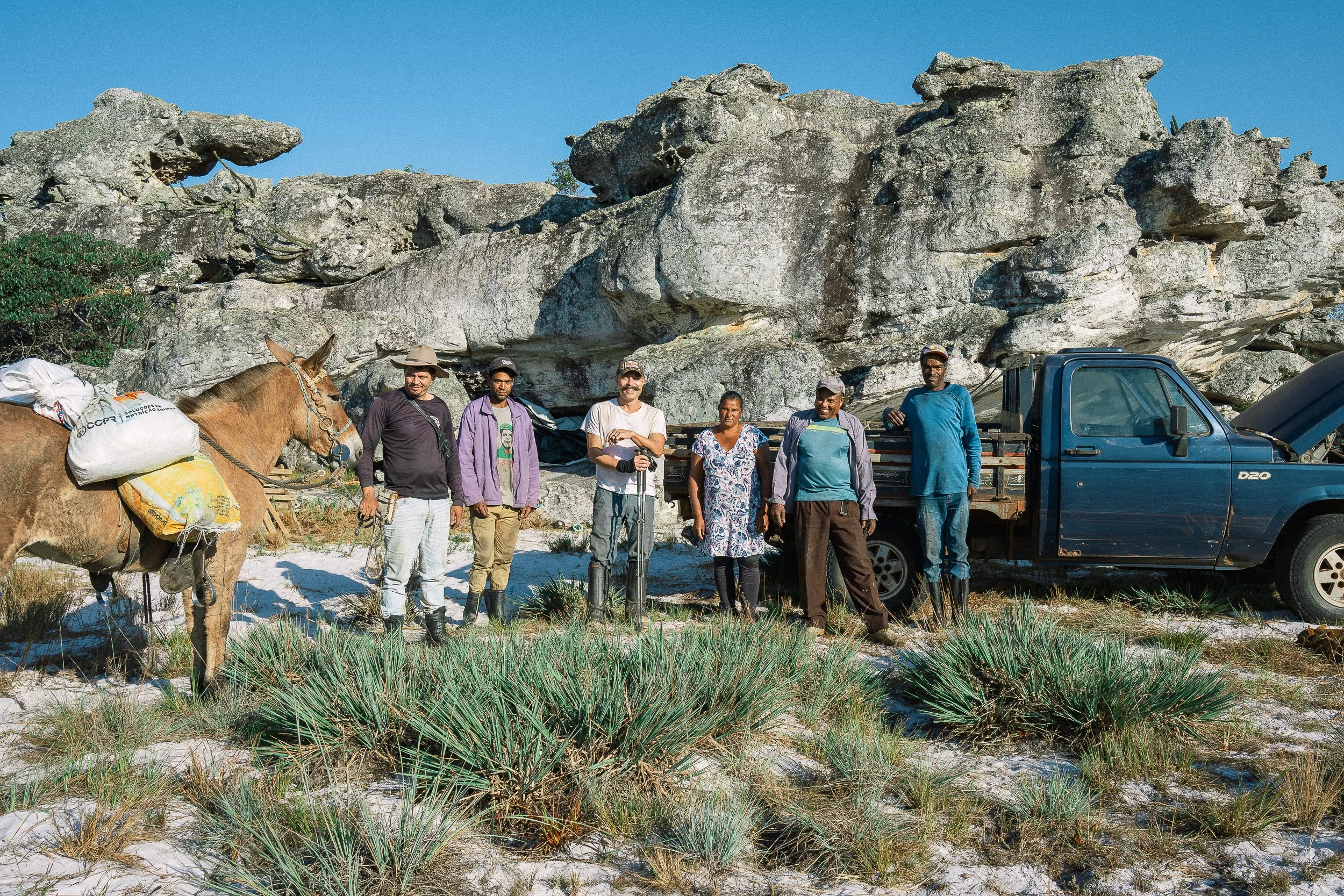
What a Crew!
Campos Tristes, Day 6
I.
FT14 | Big Picture | Impressions
Quick: what do a council meeting at a resort, an arduous bushwhack into the high campos, an oral history project, and 72 hours of backcountry partying have in common?
It turns out, quite a bit!
Even as Elisa and I headed out the door for our fourteenth multi-week field trip in the Espinhaço, the itinerary in front of us made no sense. Nor did the numbers behind it: 13 days, just 93 km on the trail (though 4,414 m of ascent/descent), and a whopping 318 km overland.
At least the route itself made sense. We’d been collecting “to-do’s” along the western escarpment of the range for months. Field Trip no. 14 was the strange sum of them.
It wasn’t until the final afternoon—drunk on exhaustion and, well, Antarctica (the beer of choice among sertanejos in the range)—that the trip’s true meaning revealed itself. Once it did, the through-line between chapters became undeniable.
The adventure itself, meanwhile, wasted no time. The lone bridge connecting our village (São Gonçalo do Rio das Pedras) to the west was closed for repairs, so the journey began with an unplanned river crossing—and a 40-minute delay.
Exhilarating dirt (dust?) roads. Cave camping (and cooking)! Gracious residents. Heroic mules. A birthday party for the ages.
And of course: some very serious bushwhacking.
After five years of meticulously planned client expeditions and (mostly) well-planned multi-week Field Trips, Elisa and I had forgotten how liberating it could be to just trust the map and ourselves, and how exhilarating it could be to just let a journey unfold around us.
Field Trip no. 14 made no sense until it did, and when it did, it changed everything.
What more could I possibly ask for in two weeks of life?
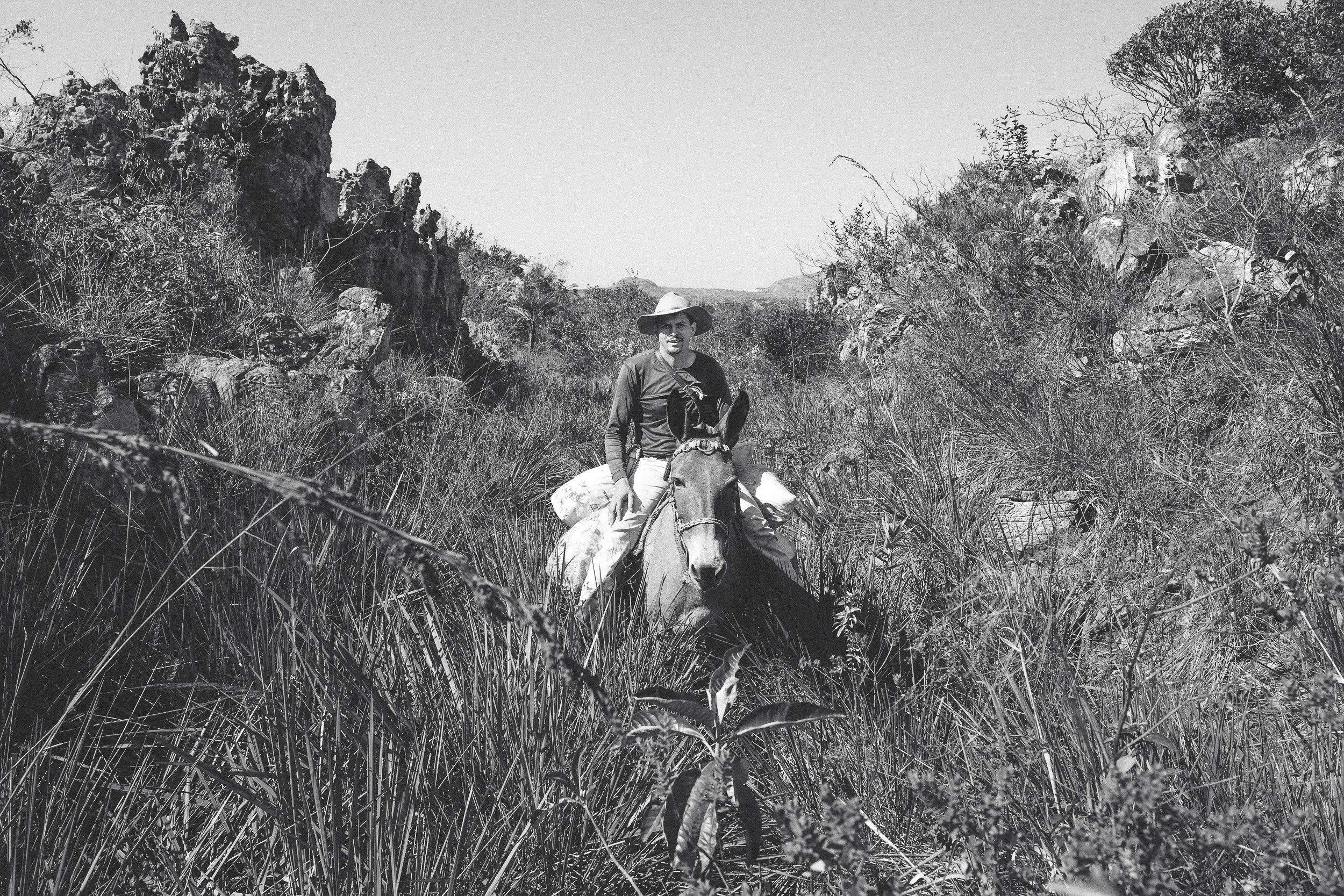
Going to Geraldo’s house.
Campos João Alves. Day 7
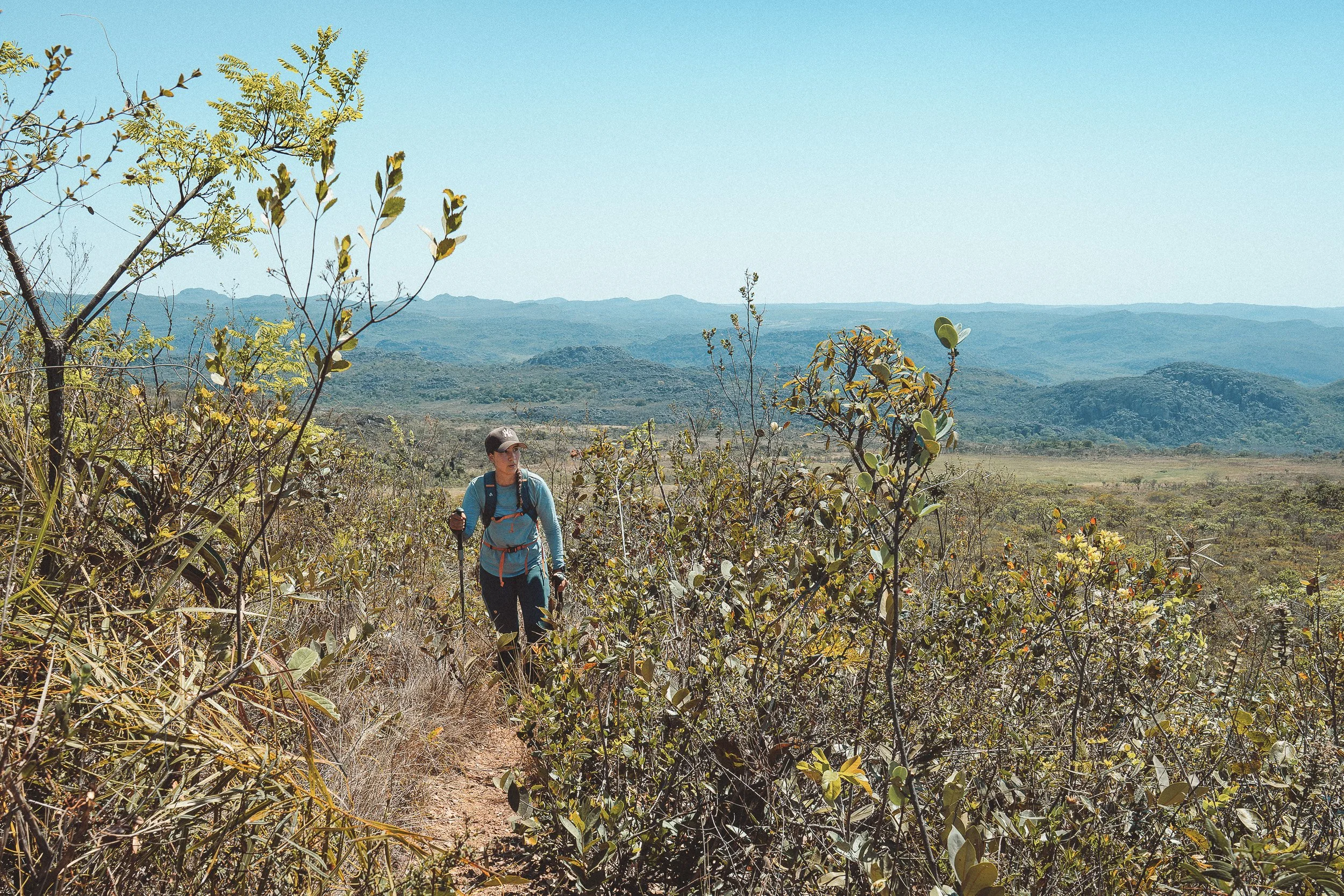
Guim & Baiana.
Apertado, Day 6
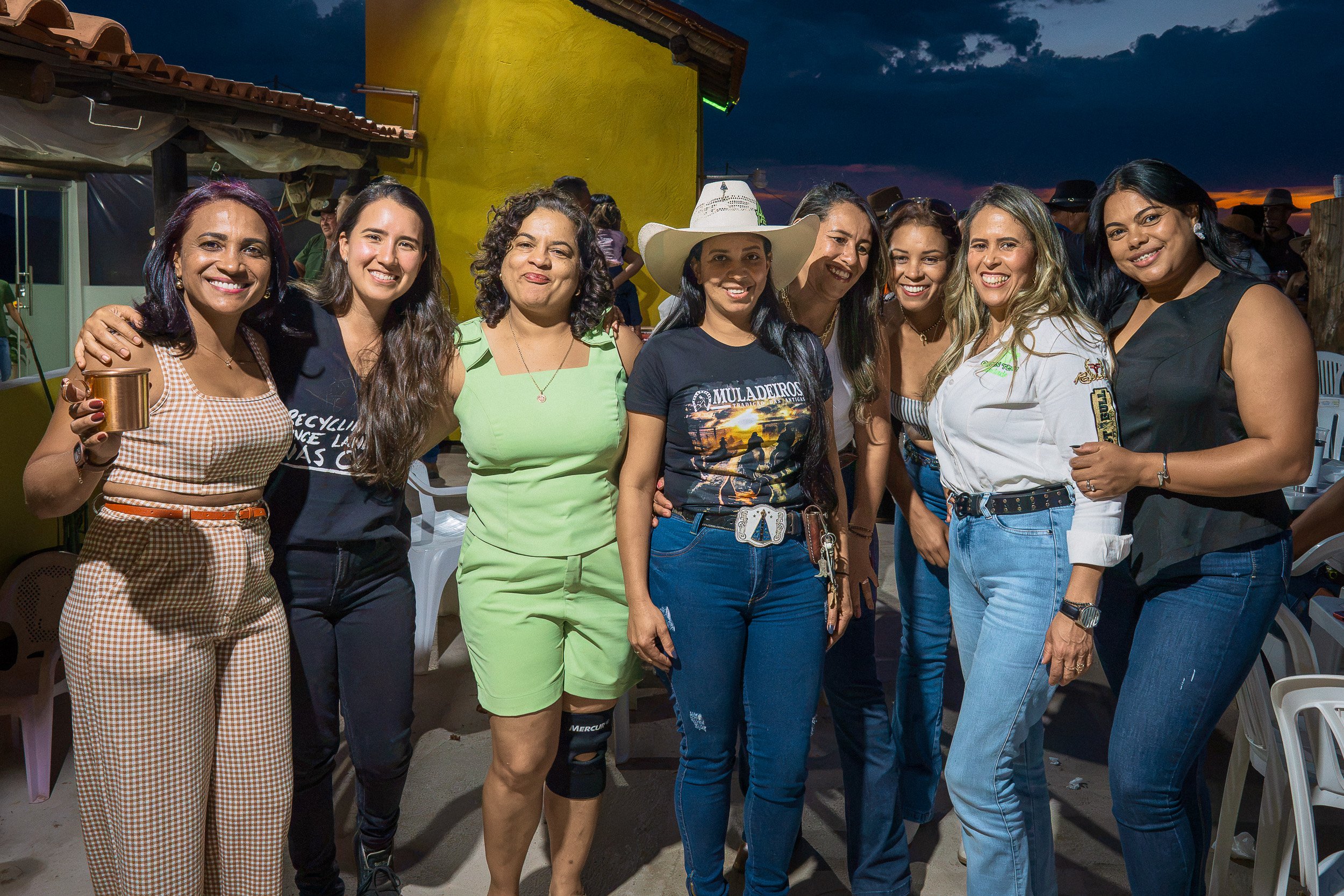
Santa Rita Crew! Guinda, Day 13
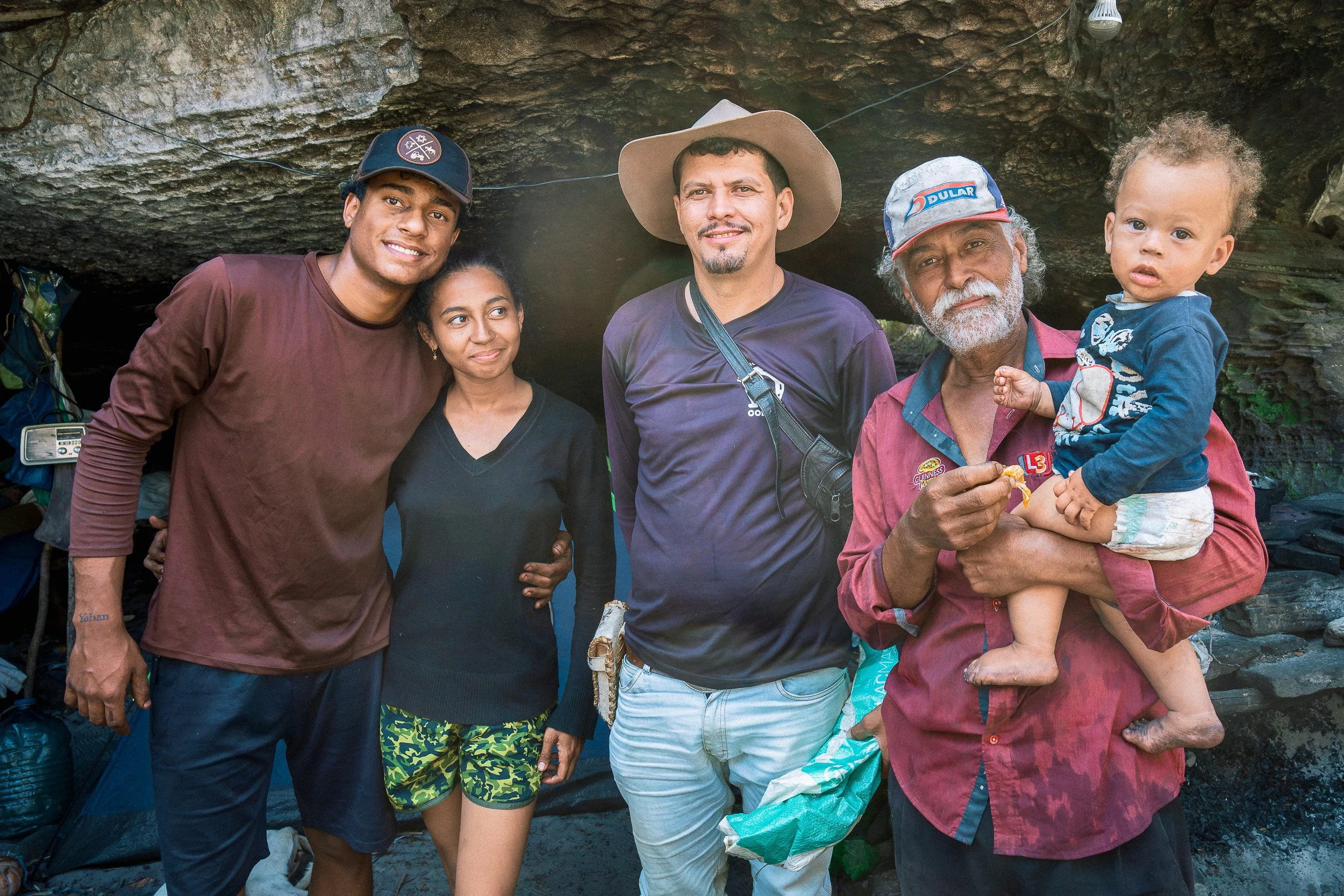
Three generations. Curimataí, Day 11
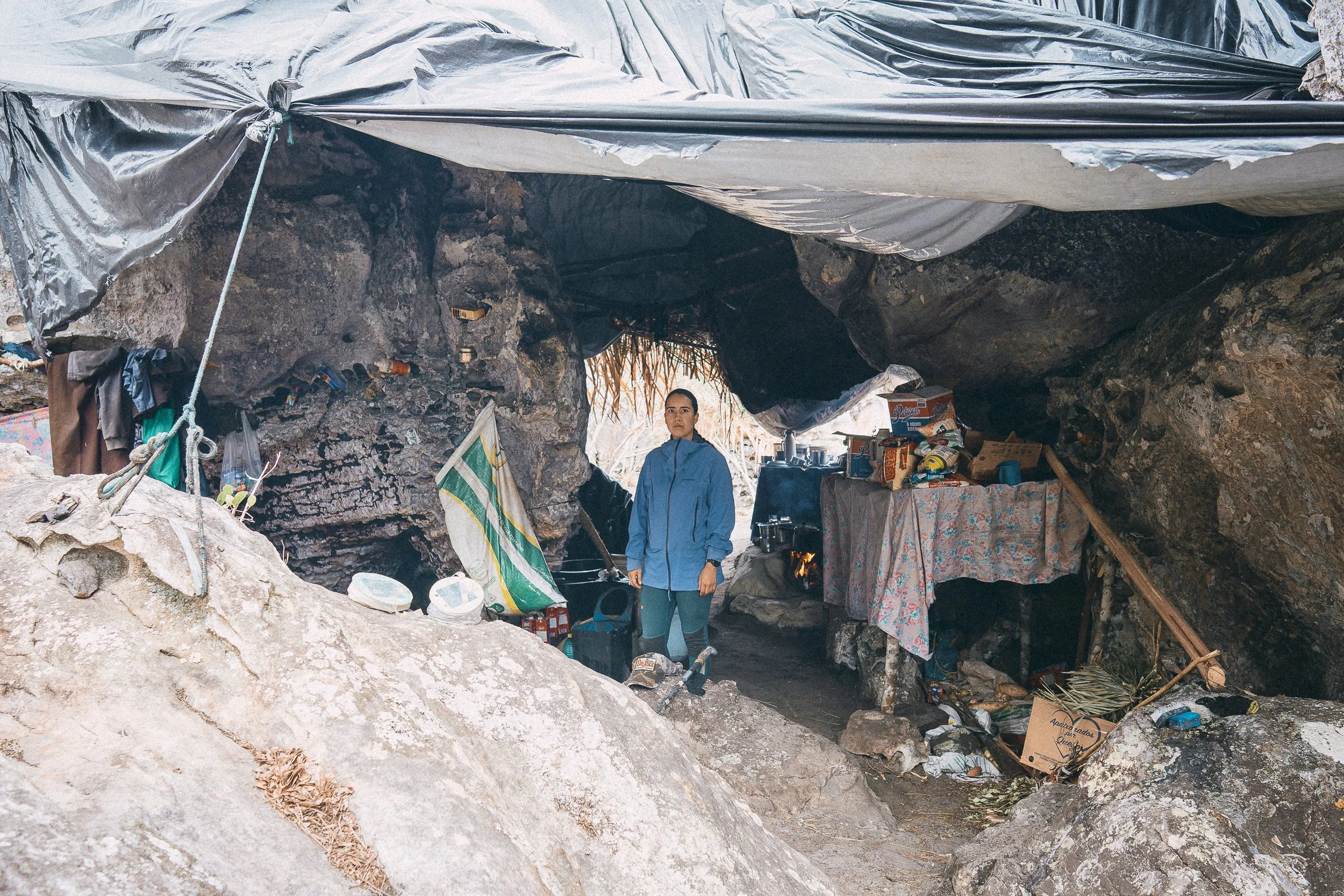
“GOGO Face”
Campos Tristes, Day 10
II.
Council Meeting | Backstory | Hot tubs
I feel like I should talk a bit about the council meeting first, if only for the aforementioned through-line reasons.
Elisa and I have been part of Sempre Vivas National Park’s council since early 2025, and are “active” members of the Park’s Monitoring and Public-Use working groups, respectively. “Active” because to date we’ve been tasked with disappointingly little. We show up prepared to meetings, ideate excitedly on projects with other members—including residents, government officials, and local entrepreneurs—and go home, awaiting further instruction. Then we repeat (with no further instruction in between).
This particular council meeting—a three-day event at the opulent (in a sertão kind of way) Aguazul Resort in dusty Teixeira that promised free round-trip van rides to/from Diamantina and all-you-can-eat pizza—was more of the same: highly promising, modestly productive, and profoundly concerning.
Sempre Vivas is a complicated place, with an exceptionally complex history, and one of these days I’ll get around to writing more about it. In the meantime, know this: the administration could not be more welcoming, respectful, or well-intentioned, and the council is exceedingly diverse and convivial.
It was certainly fun and a different kind of productive to hang out in mineral water hot tubs after hours with colleagues each night, drinks in hand, but it’s hardly the part of the field trip I’ll remember.
In fact, if I’m honest, in the short weeks that have followed, I’ve forgotten what was “decided” at the meeting at all.
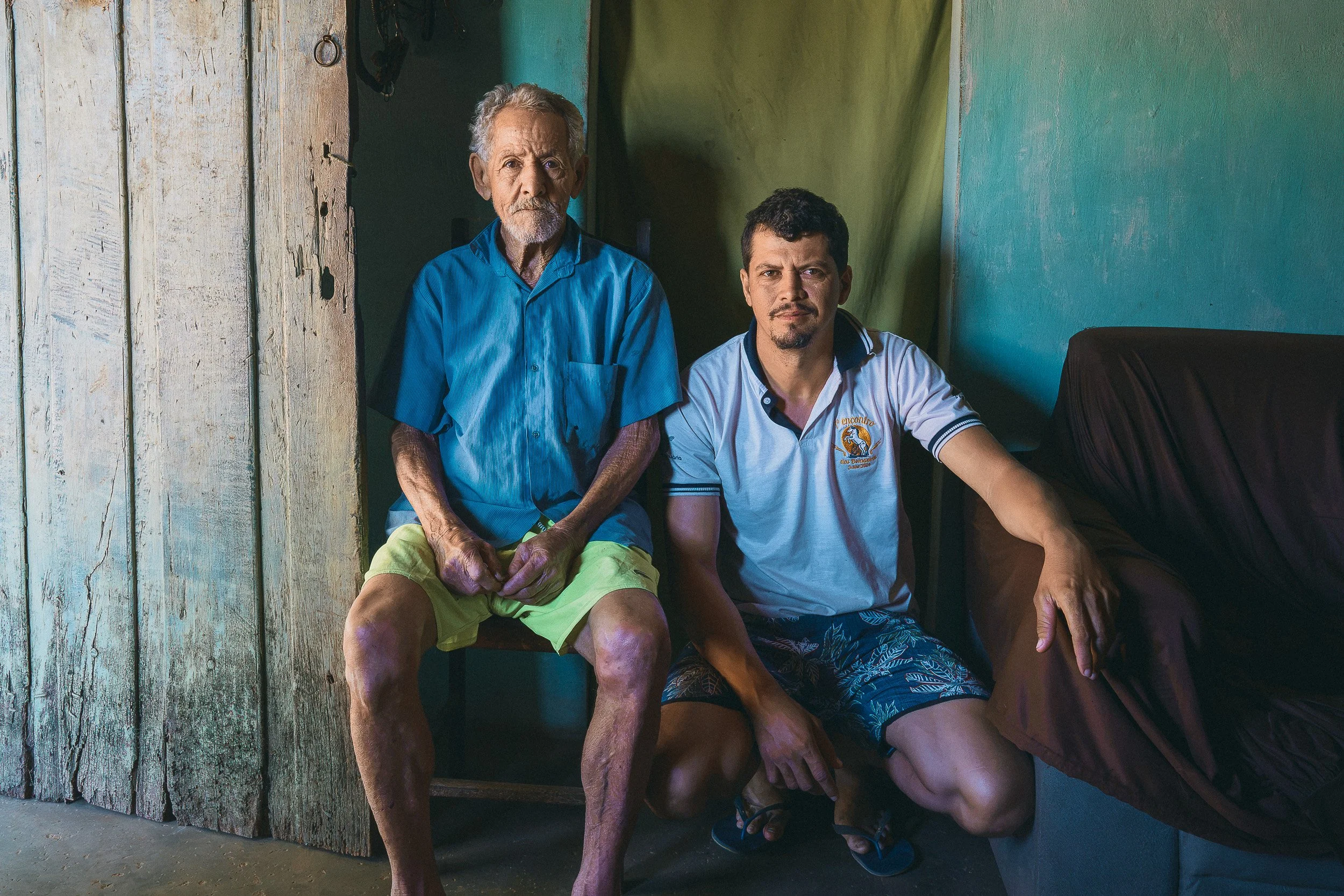
Moises & Guim.
Pê de Serra, Day 11
III.
A Logistics Day | Pé de Serra | Guim & Moises
Unlike the first leg of the field trip (and the third one—though for entirely different reasons; more on that later), I vividly remember seemingly every detail of the second leg:
a six-day journey that was at once one of the most profound cultural explorations I’ve ever been a part of and one of the most grueling and exhilarating short (93 km) treks I’ve ever done.
A quick timeline: After the council meeting ended on Day 3, Elisa and I drove to Curimataí, where we sharpened our machetes and picked up a hatchet, some rope, and a 2 L bottle of excellent local cachaça. (Curimataí may only have one small grocery store, but it has everything a backcountry researcher could ask for—including a self-serve bucket of delightfully assorted knives.)
We visited the local National Park crew at their newly renovated base in town—the same people we’d met just hours earlier in Teixeira; remember the through-line?—then drove to Gilma’s to drop off our laptops and “party duffels.”
From there, we met Guim and followed his motorbike to Pé de Serra. Elisa and I had shared a few words with Guim before at various parties in the region (we’ve been known to attend a few), but we’d never had a chance to spend time with him, visit his home, or work with him. When we arrived at his house at—literally—the pé da serra (foot of the mountain), we were unexpectedly greeted by a familiar face: Biscoito (“Cookie”), one of the Park’s brigadistas, who we’d had the pleasure of visiting with on more than one occasion at the Park’s lone working facility in the high campos, Casa Kolping.
It turns out that Biscoito is Guim’s older brother—one of eight older siblings, if I’m not mistaken.
Shortly after dinner, their elderly father, Moises, returned from a doctor’s appointment in BH (immediately upon stepping into his home, he shook Elisa’s and my hands, looked straight into our eyes, apologized for the state of the house, and told us “You are welcome here. Whatever it is that we can offer you, I hope you understand that you deserve double.” I honestly don’t think I’ll ever forget that). Stories began to flow: about the histories of the fields we’d be crossing over the next few days, the trails that linked them, and the prospectors, miners, ranchers, and flower-pickers who lived along them generations ago when Moises himself was a young and entrepreneurial man.
I’d traveled certain stretches of the route we’d be traveling the next day with Júlio during Field Trip no. 3 (in 2022), but my memory from that trip was hazy. The only thing I recalled clearly was a promise I’d made to myself that I would never attempt one particular stretch of forest again. The feelings—of fear, exhaustion, relief—had far outlasted any specific names, trails, or scenery.
In our search for a local guide in the weeks immediately leading up to the trip, Elisa had received Guim’s contact from his cousin Pedro Henrique—the cousin of André (who is the son of Erica) in Macacos (this is how field work works). Moises assured us that Guim would know the way and that all would be fine, but after his father went to bed, Guim expressed some doubt. It turns out, he hadn’t been to Campos João Alves since he was 12.
Guim is 37.
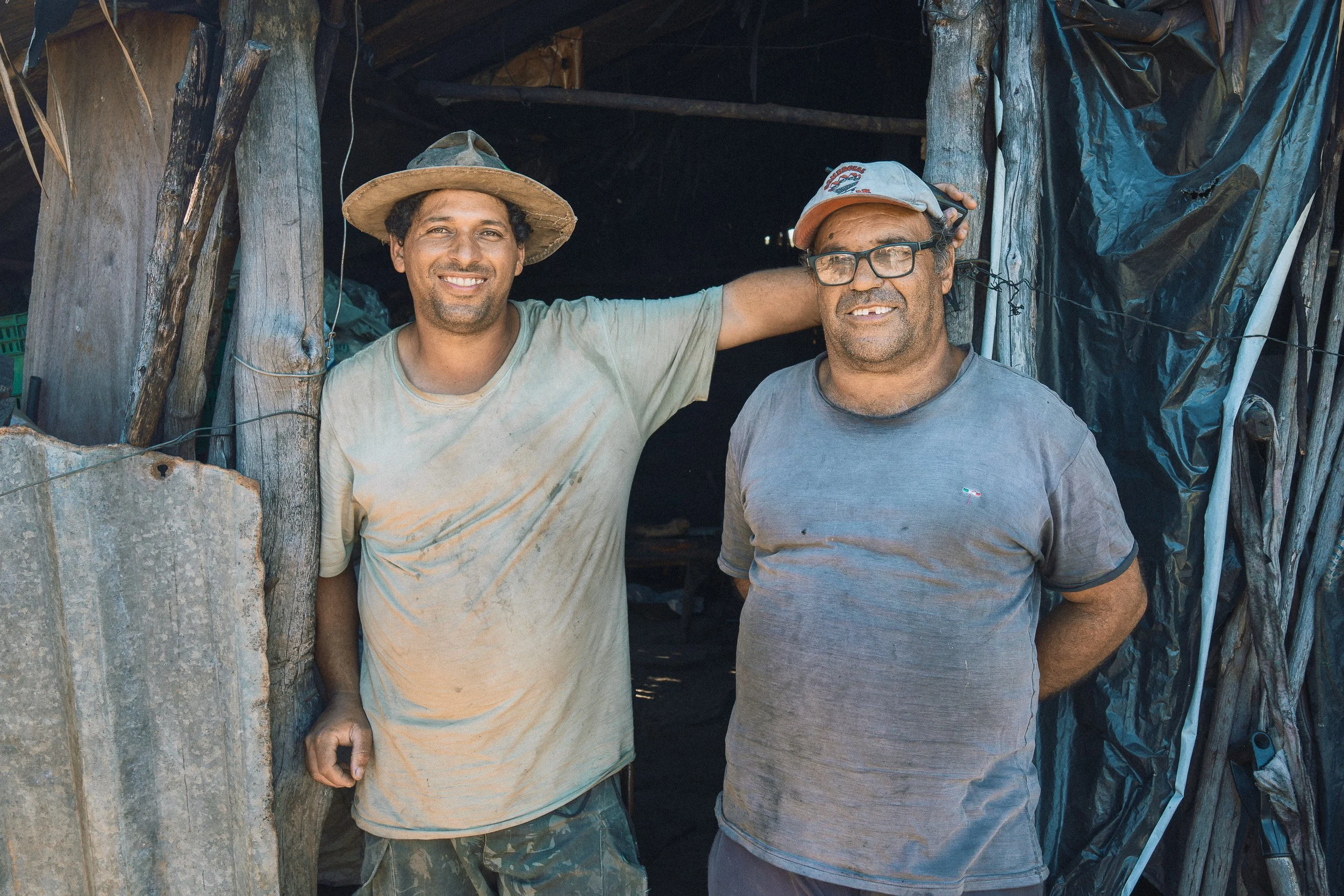
Deivid & Geraldo
Field Trip no. 13
IV.
Another Backstory | Campos João Alves | Geraldo
It occurs to me that I haven’t yet mentioned where we were heading and why.
In July, during Field Trip no. 13, as Elisa, Luca, Tiago, and I were making our way from the lush valley of Folheta to the daunting forests of Taquaral (and eventually beyond to Macacos), we passed through the flowery fields of Campos João Alves, one of the Park’s most secluded high campos. During that traverse, we happened upon Geraldo, patriarch of the last family residing full-time in Sempre Vivas National Park, resting in the shade at a freshwater spring.
He invited us to his home—a rustic wooden rancho, strikingly photogenic and surprisingly comfortable. Alongside his 31-year-old son Deivid, he spent the afternoon telling us about the fields and his family over café, fresh fruit, and delicious homemade biscuits. (Luca and Tiago still insist they were the best thing we ate on the entire trip. The recipe is almost absurdly simple; the magic must be in the preparation.)
Elisa and I had actually met Geraldo once before, fleetingly, during Field Trip no. 3 in 2022. That he remembered us four years later was remarkable. Apparently, few others had visited in the intervening years.
But it was this afternoon in July—our first opportunity to really sit and talk—that truly marked us. Geraldo’s knowledge of the fields and their history was extraordinary. He mentioned having briefly started a YouTube channel years earlier to share what he knew about local medicinal plants with people around the world—an endeavor he’d abandoned due to both the effort required to post videos from his home (even today, signal can only be had from a specific point atop a nearby serra) and the lack of attention the content received.
I wondered if he might like to share his other stories and perspectives.
I reminded him I was not a journalist or an author. I’d been exploring the Espinhaço and documenting the range and its residents for nearly a decade, but at the end of the day, Expedition Leader status aside, I was just a curious traveler with a camera. We had iPhones and a nice Sony camera. Drones, tripods, and microphones. He understood. The most important part, I think, was that we wanted to listen. And that he wanted to share.
He said he would like that opportunity very much. Elisa and I said it would be a pleasure to come back.
I took some pictures of Geraldo and Deivid in front of their home, and we thanked them and told them we’d be back soon.
As the sun began to set, Deivid escorted us through the fields to the entrance of Fundão, a valley Elisa and I know well, and where we would set up camp that night alongside the waterfall near the old Telegraph line bridge.
In early August, we sent them photographs from the trip and Elisa began coordinating possible return dates. We had a council meeting at a resort in that part of the Espinhaço in late August, and there was a party in Curimataí in early September that we’d been hoping to attend as part of our rural festa tour. Maybe there’d be an opportunity to visit their family again in between those dates? To put them all together in a single, slightly odd field trip.
We laughed at the thought of it, but kept the possibility open.
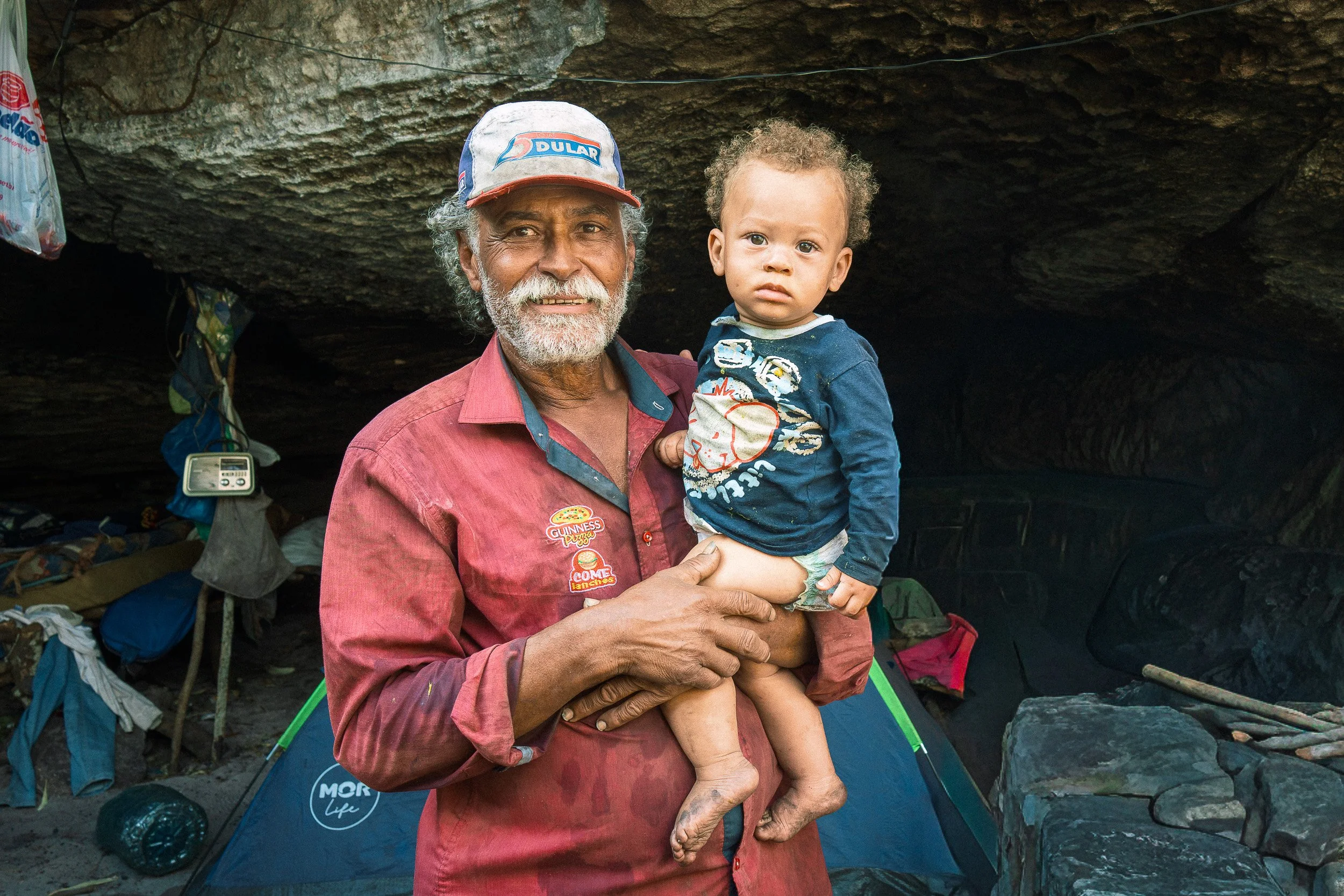
Alves & Miguel
Day 6
V.
Into the serra | Baiana | Alves | The land becomes legible
On the morning of Day 5, Guim, Baiana, Elisa, and I began our journey to Geraldo’s house in Campos João Alves.
Baiana is Guim’s favorite mule (he has two), but to reduce her to simply “a mule” feels wrong. Resilient, moody, and stubborn, she was an exceedingly valuable part of our crew, carrying our food and heaviest equipment. When my arms grew exhausted from cutting palms and ferns, she became a four-legged battering ram (or maybe a sort of super-sized mortar and pestle?), leaping and stomping through the brush ahead of us.
Guim’s fondness for animals was evident before we even hit the trail: he’d already tended to his chickens, dogs, cats, and mules by the time we woke. But his patience and genuine affection for Baiana was something I hadn’t witnessed among horsemen in the Espinhaço.
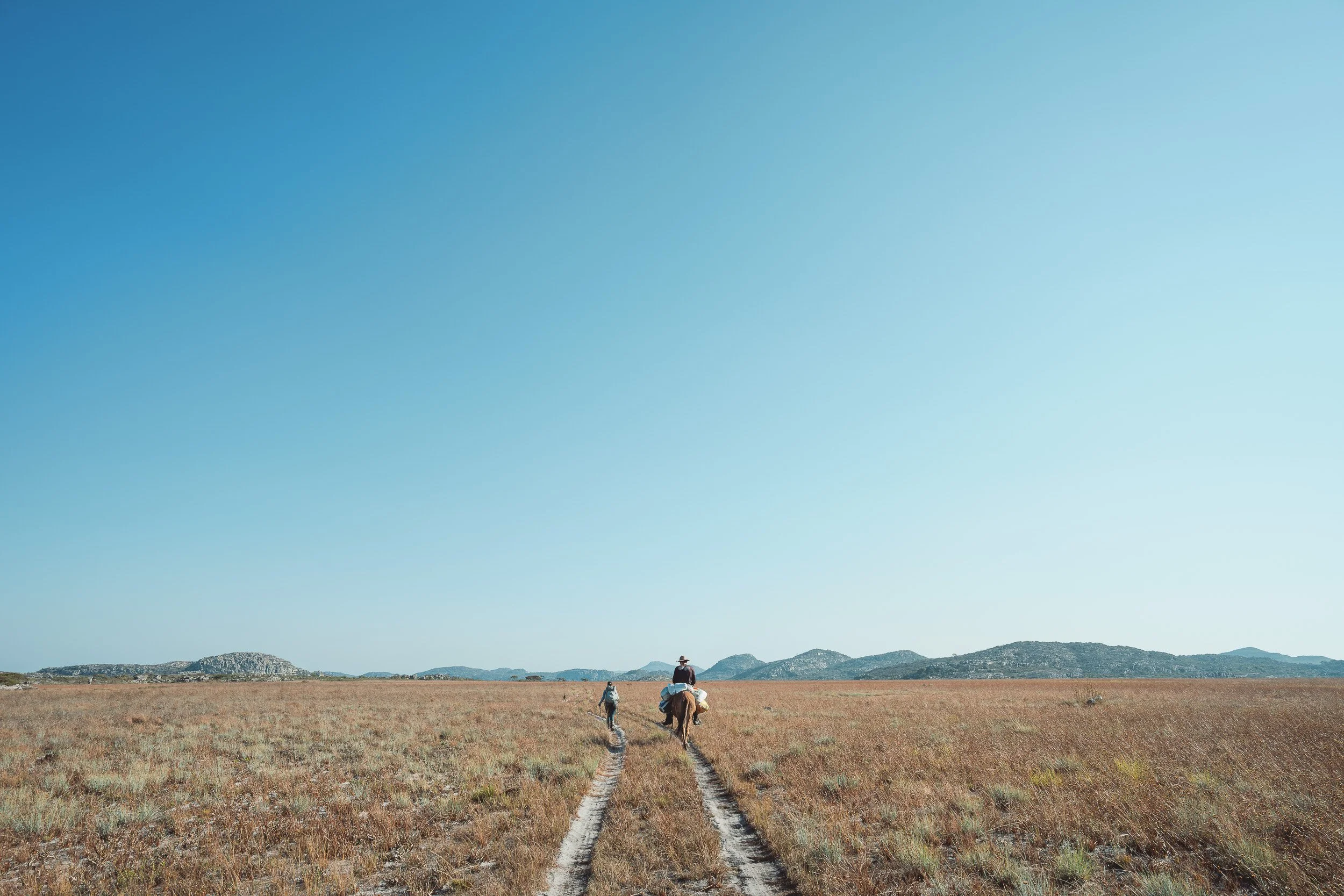
The trail from Pé de Serra into the serra begins the way all journeys along the western escarpment of the Espinhaço do: brutally and immediately upward. An exposed 7-km ascent along a rocky slab leads to breathtaking views of the Jequitaí River valley and is followed in quick succession by a descent along an old mining road and a pair of substantial river crossings. This is followed by another (worse) 7-km ascent along a winding historic trail: sand, dirt, and loose gravel pull you upward through pockets of dry forest and long shadeless stretches of campo sujo.
This is where we met Alves, a second-generation flower-picker who was raised in a lapa (rock shelter) near Campos Tristes. He and his mule had just returned with “product” (flowers) from those high fields, and were making their way back up from Pé de Serra with supplies for his family. The chance meeting was a joyous occasion for all of us—it’s not often that one comes across another traveler on the trail in Sempre Vivas these days (consider: in nearly 50 days of total walking in the park since 2019, the only travelers Elisa and I had ever come across on a trail prior to this trip were a pair of poachers in 2024). That joy went a long way during the scorching final kilometers to the top of the plateau, where the gravel, forests, and cliff faces end and the blue skies, white sand, and tall grasses that typify the high campos begin.
As we walked, Alves (an elder relative of Guim, but whose relation remains unclear to me) animatedly told us stories about our surroundings—a dried up creek here, a distant grove of palms there, the trail beneath our feet—laughing and smiling broadly at times, and other times his voice trailing off wistfully. He’d kindly offered his mule to Elisa on the way up to the campos, and now on foot and carrying her substantial pack, he was impressive. (Almost without exception, the best walkers I’ve traveled with in the range have been men from the old generation.)
By the time we reached his shelter, the landscape had taken on a completely new meaning. How many times had I traveled these fields superficially, always wishing to understand their meaning without ever coming close? Now, where I had only seen grass and flowers, I saw a football field. A lonesome rocky outcrop became the home of eight families—parents drying freshly harvested flowers and cooking dinner, children laughing and running wild, babies playing in the sand. There were parties here. Full-moon forros. Cachaçinha. Shared labor and shared joy.
In the span of just a few short kilometers, Alves had completely transformed my reading of Sempre Vivas.
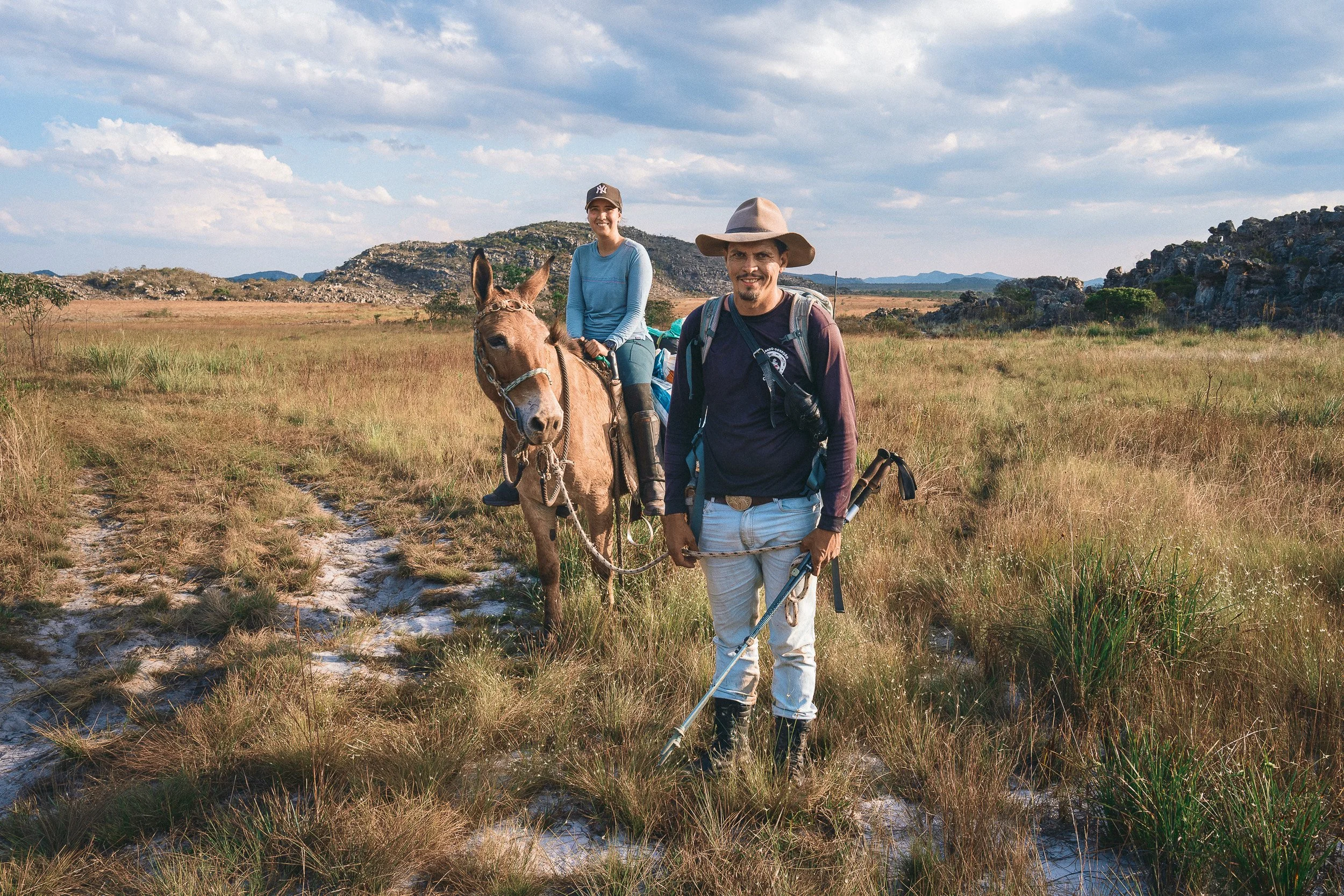
These two. Areia Branca. Day 5
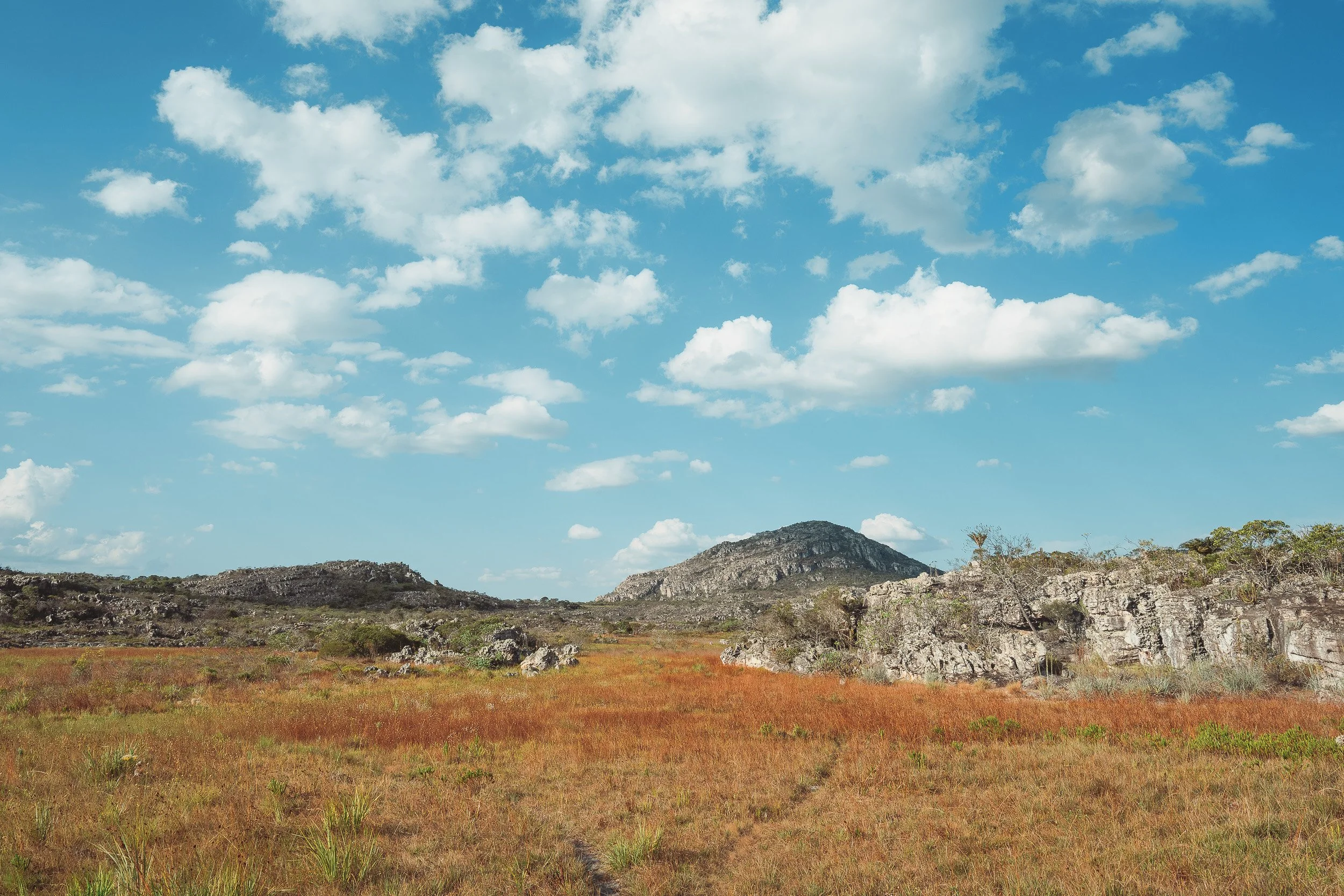
The road ahead.
Campos tristes, Day 5
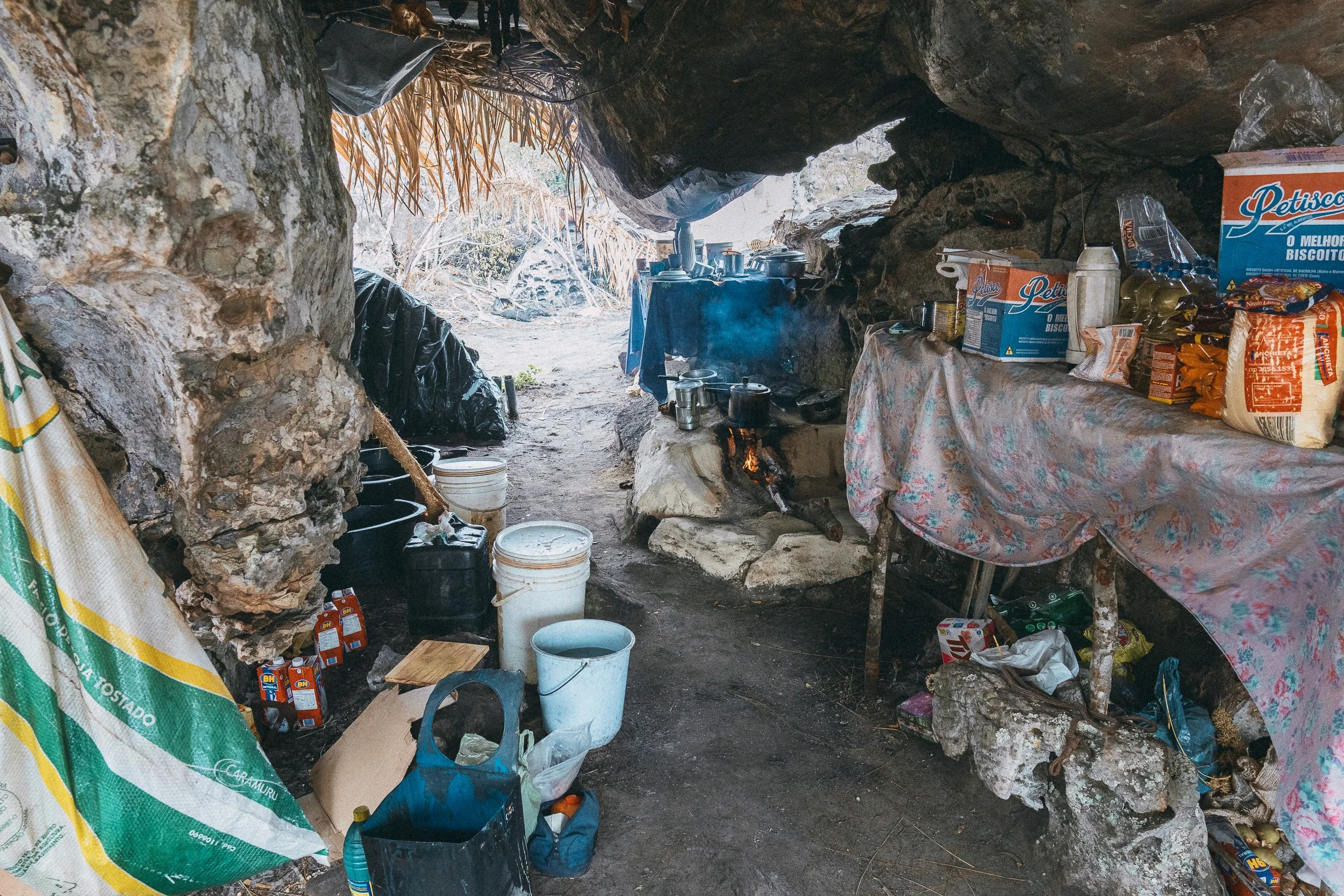
The kitchen
Campos Tristes, Day 6
VI.
Campos Tristes | Leandro’s cave | The kindness of strangers
After several large plastic mugs of wood-fired café and a few hurried portraits with the Sony, Elisa, Guim, Baiana, and I said goodbye to Alves and his beautiful family and continued our journey east towards the center of the Park.
The hottest part of the day was behind us, and Campos Tristes was just six kilometers away. We arrived in its vast sala (literally, “room”—a word I’ve long used to describe the windswept fields in this part of the Espinhaço, which are revealed only upon stepping into them between mountains) at golden hour and began searching for water. The plan was to make camp near a stream—a seemingly simple task that was looking increasingly difficult. In the wet season, Campos Tristes is an endless green marsh. In September, it’s a vast straw-colored desert.
As we were searching for signs of water, a voice called out to us from the rocks. A man appeared seemingly out of nowhere, waved excitedly, and jogged out to visit us. He shook our hands, exchanged a few words with Guim, and (after a careful examination of my mustache and accent) proudly held up a jug of water.
Suddenly we had both water and a place to pitch our tents.
______
Leandro’s cave (or a lapa do Leandro, as we have now unofficially named it; I believe locals know it by several names, most of which involve long descriptions, multiple directions, and repeated affirmations) is in fact not a single rock shelter, but a complex of rocky overhangs linked by foot paths and an ingenious tunnel covered by a large tarp and traditional Indaiá-leaf roof.
The tunnel is paramount: it simultaneously acts as the kitchen, half of the common area (the other half is just outside of it, where the nightly bonfire happens), and a hub for the complex’s many trails. It’s more than the rug that ties the room together: it’s structural and makes the whole place feel lived-in and quite frankly cozy.
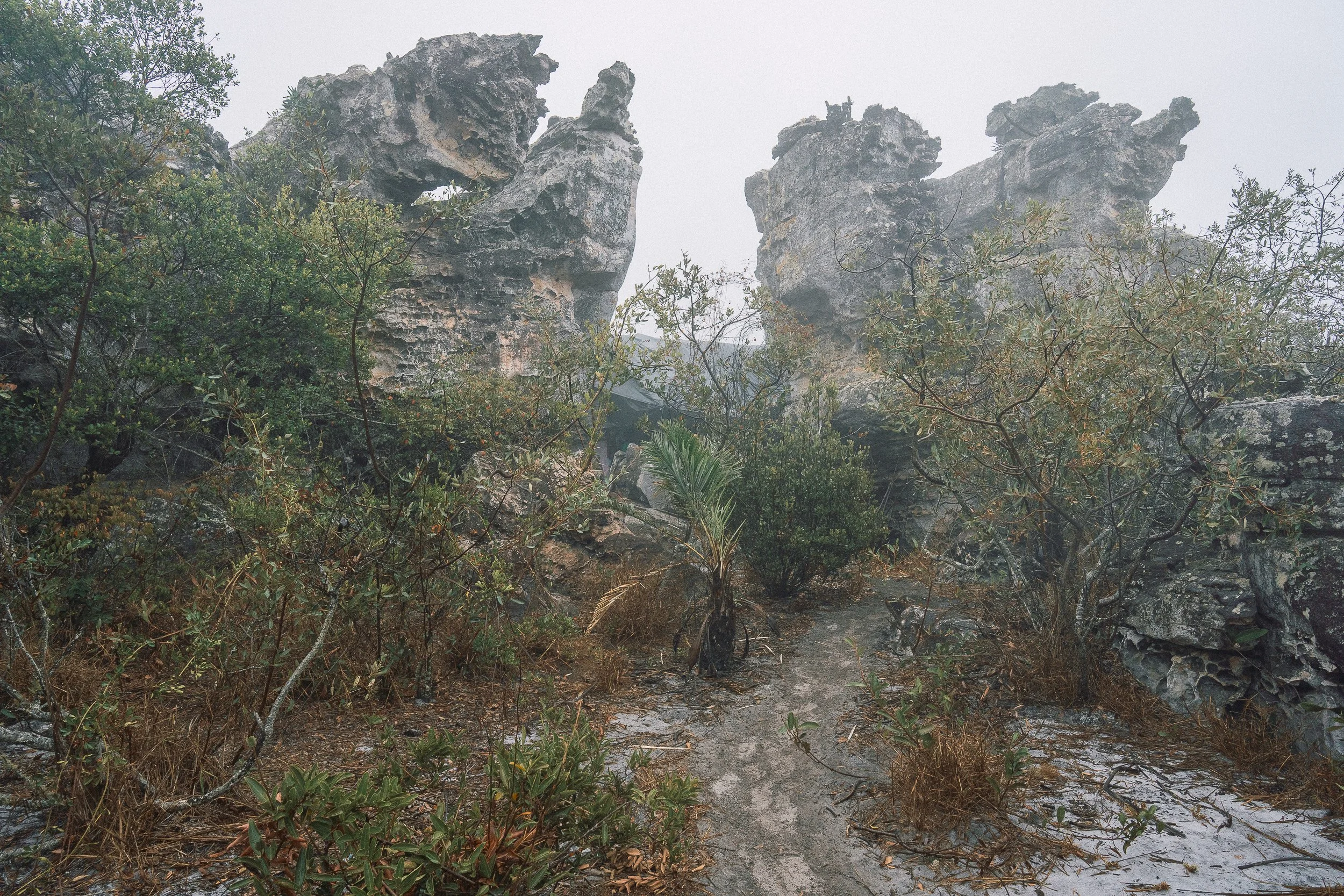
Elisa pitched our tents under a large overhang at the end of the complex closest to the fields. Guim had never slept in a tent before and was equal parts excited and nervous (he later reported to have slept like a baby). I was charged with dinner and opted for mujadara—a relatively simple Arabic spiced lentils and rice dish we often eat on the trail that I learned from my ex-wife, whose mother was Syrian. I’d planned on cooking with our tiny camp stove, but Leandro insisted we take full advantage of the kitchen, and I was more than happy to oblige. The wood-fired stove was impressively well-made, with white tabatinga clay sourced nearby (Leandro claims to have discovered it only by following the ants), firewood was plentiful, and the tunnel factor meant smoke moved quickly out of the kitchen as opposed to hanging around the cooking area (something that in my experience can make wood-fire cooking a multi-dimensional challenge).
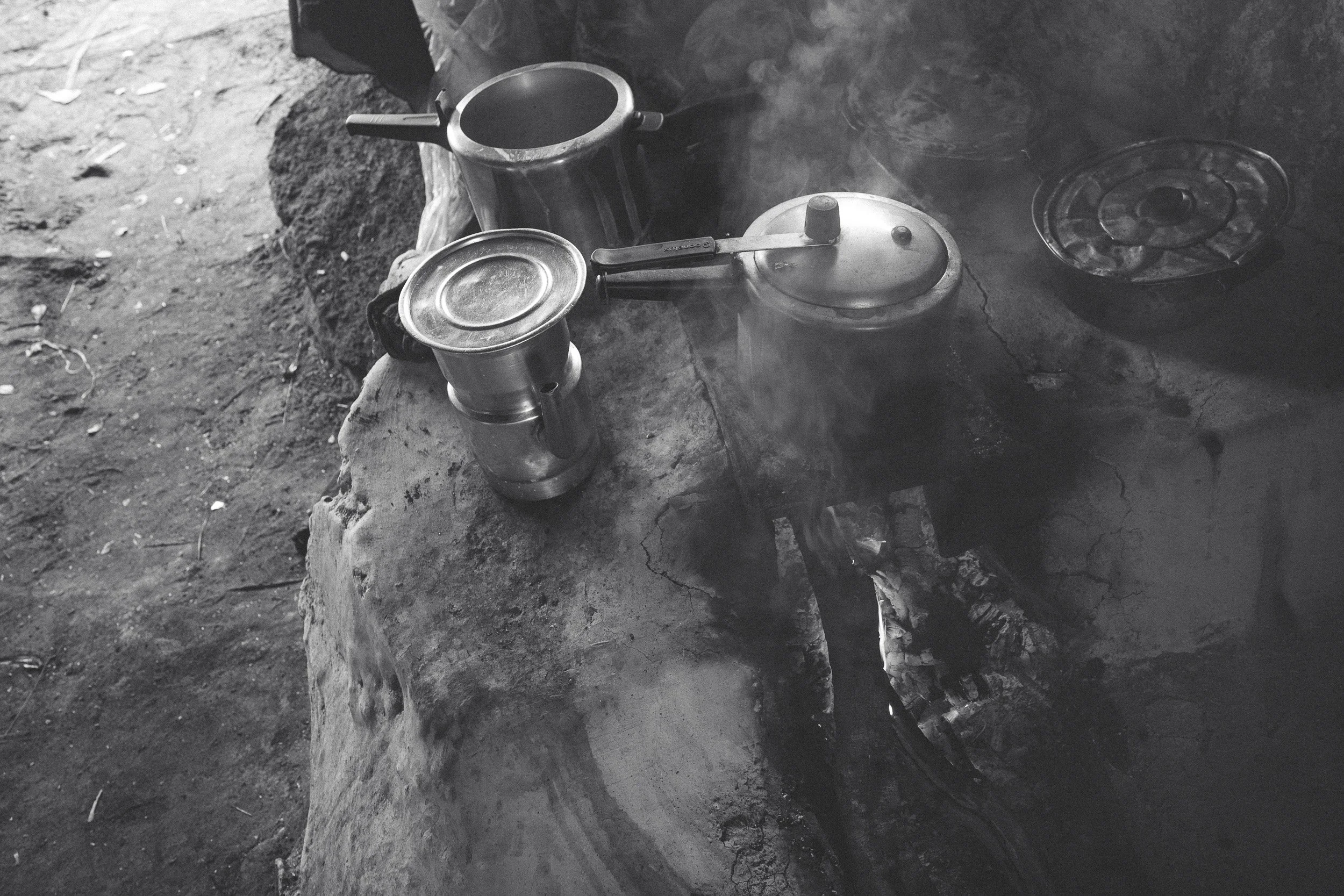
There was an audience hovering nearby as I cooked—Leandro and his wife Silvia, and Gonçalo and his son Ronaldo, all seated on various rocks and buckets—which induced a bit of anxiety. In a bit of coincidence that can’t be overstated, I had met each of them briefly before in other parts of the Espinhaço: Silvia at her home in Amaral in 2021 (while visiting a trio of waterfalls with Júlio), Gonçalo on the road to Serra da Bicha in 2022 (Elisa and I gave him a ride on our way to climb Pico do Itambé. He was returning from Capivari, 9 kilometers away, where he’d just voted. He was barefoot.)
As I cooked, the conversation, like the fire, required a bit of attention. At times the tunnel became dauntingly quiet, and I would find myself trying to both entertain and work the stove. It was quite clear that none of them had seen a gringo cook on a wood-fired stove before, which must have been its own sight after two months in a remote lapa. Once the cinnamon (intentionally) went into the rice and “beans” though, I could almost feel the tunnel gasp.
I’d long heard stories from garimpeiros, tropeiros, and flower-pickers about “the good ‘ol days” when strangers and acquaintances from across the range would gather in caves, work the land together, share meals, and huddle around the fire at night. As I stood there by the bonfire, surrounded by these kind people, the long silences between stories now comfortable, I was as grateful as I could ever remember.
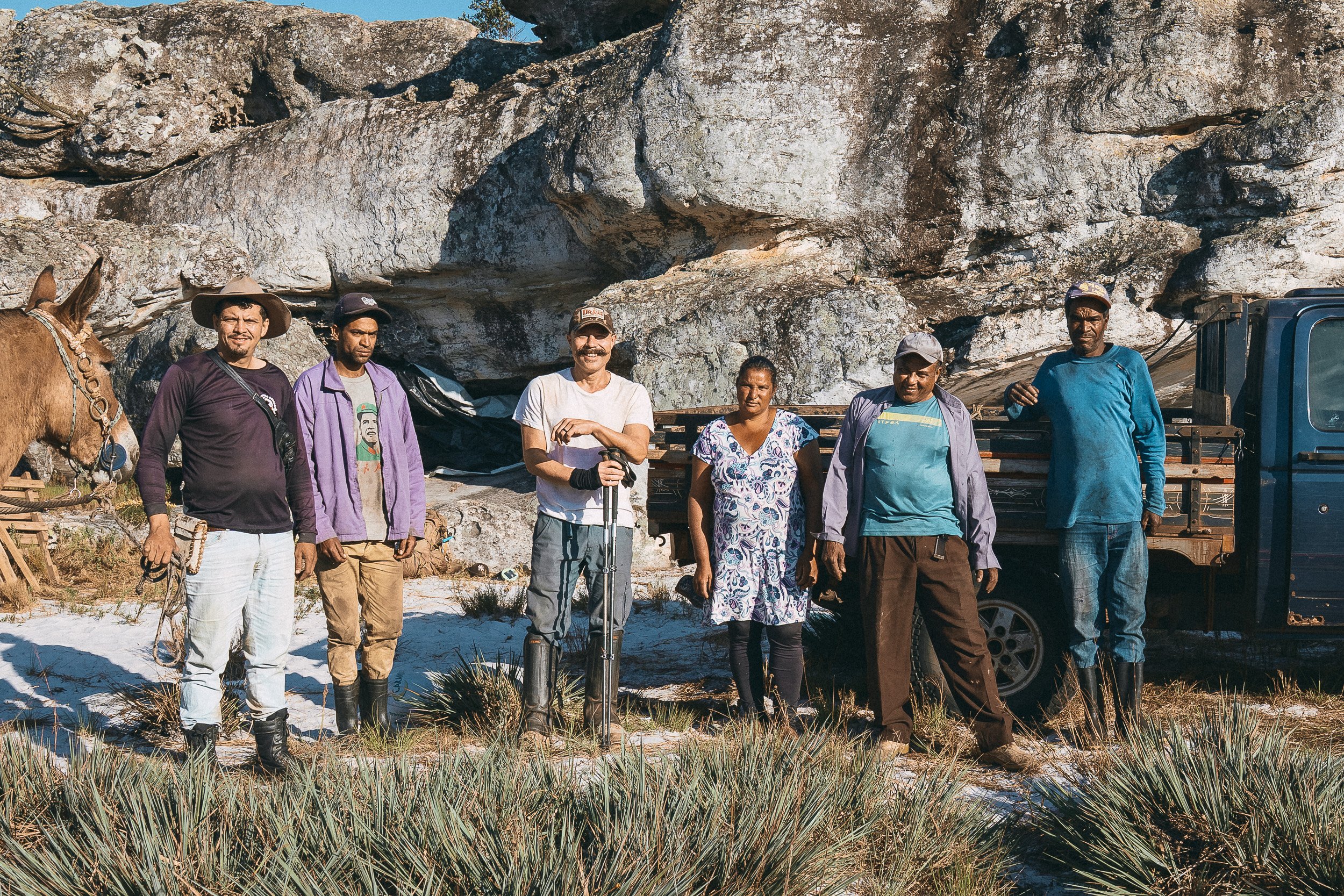
The Campos Tristes crew.
CAmpos Tristes. Day 6
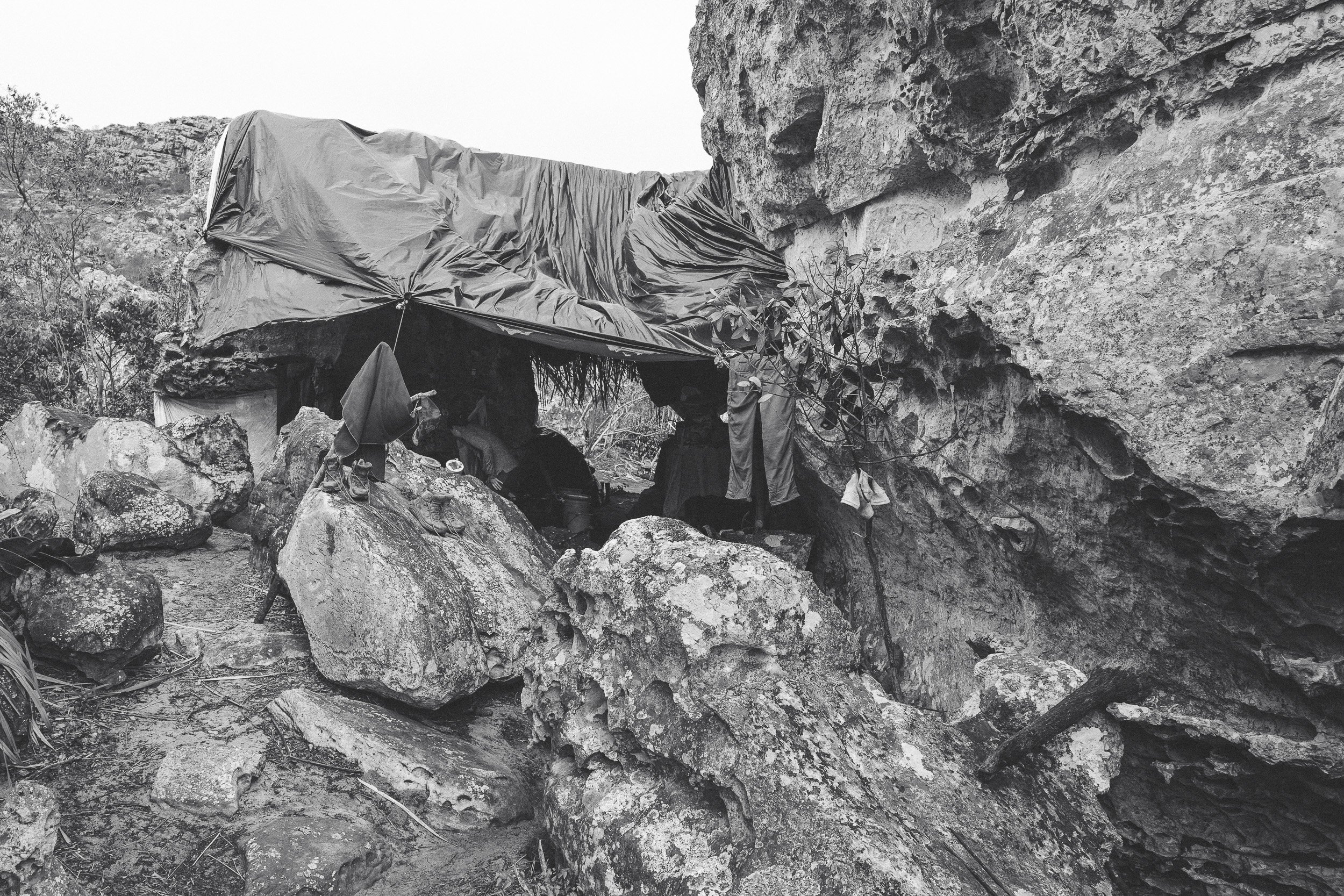
The Kitchen.
CAmpos Tristes. Day 10
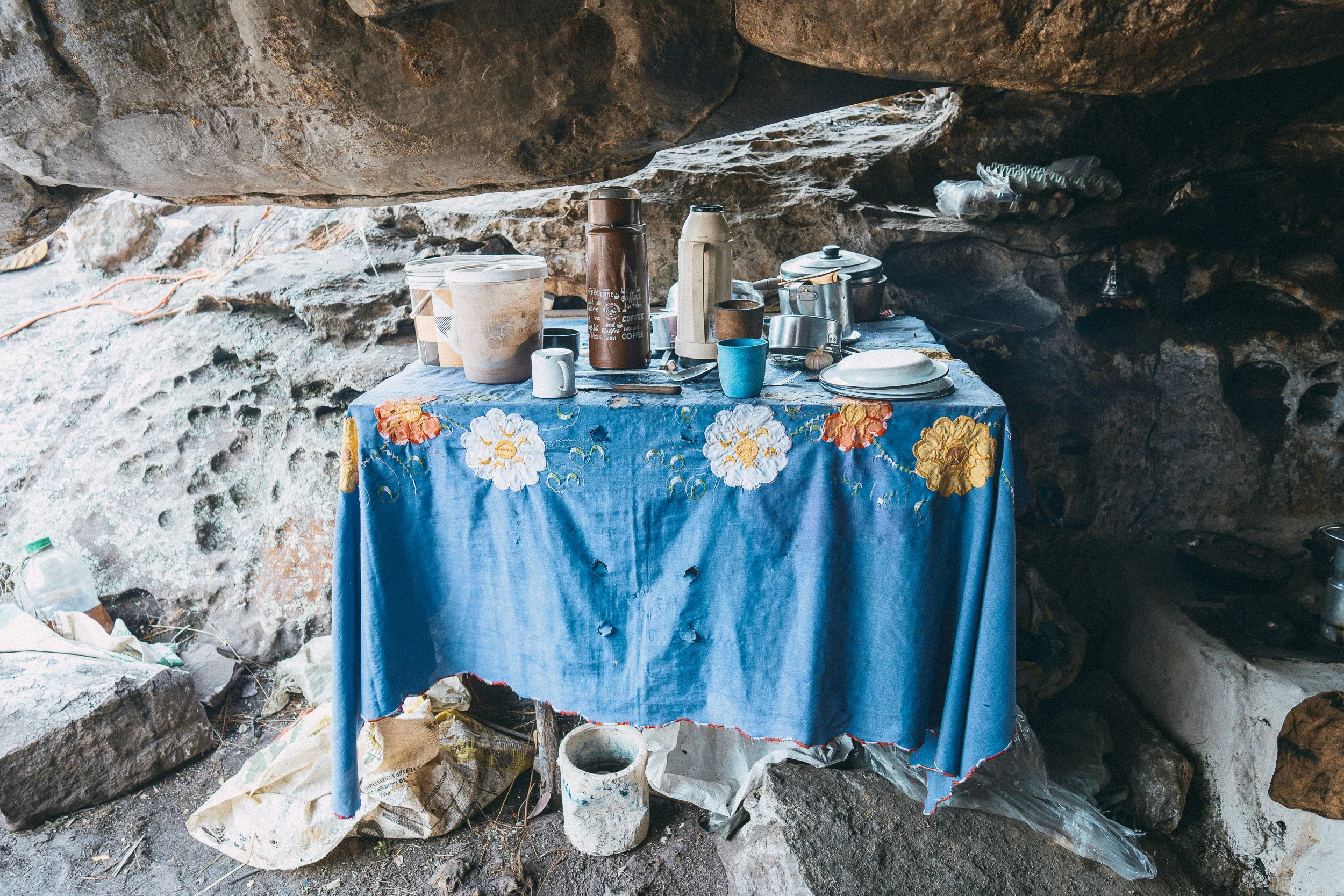
Breakfast table.
CAmpos Tristes. Day 6
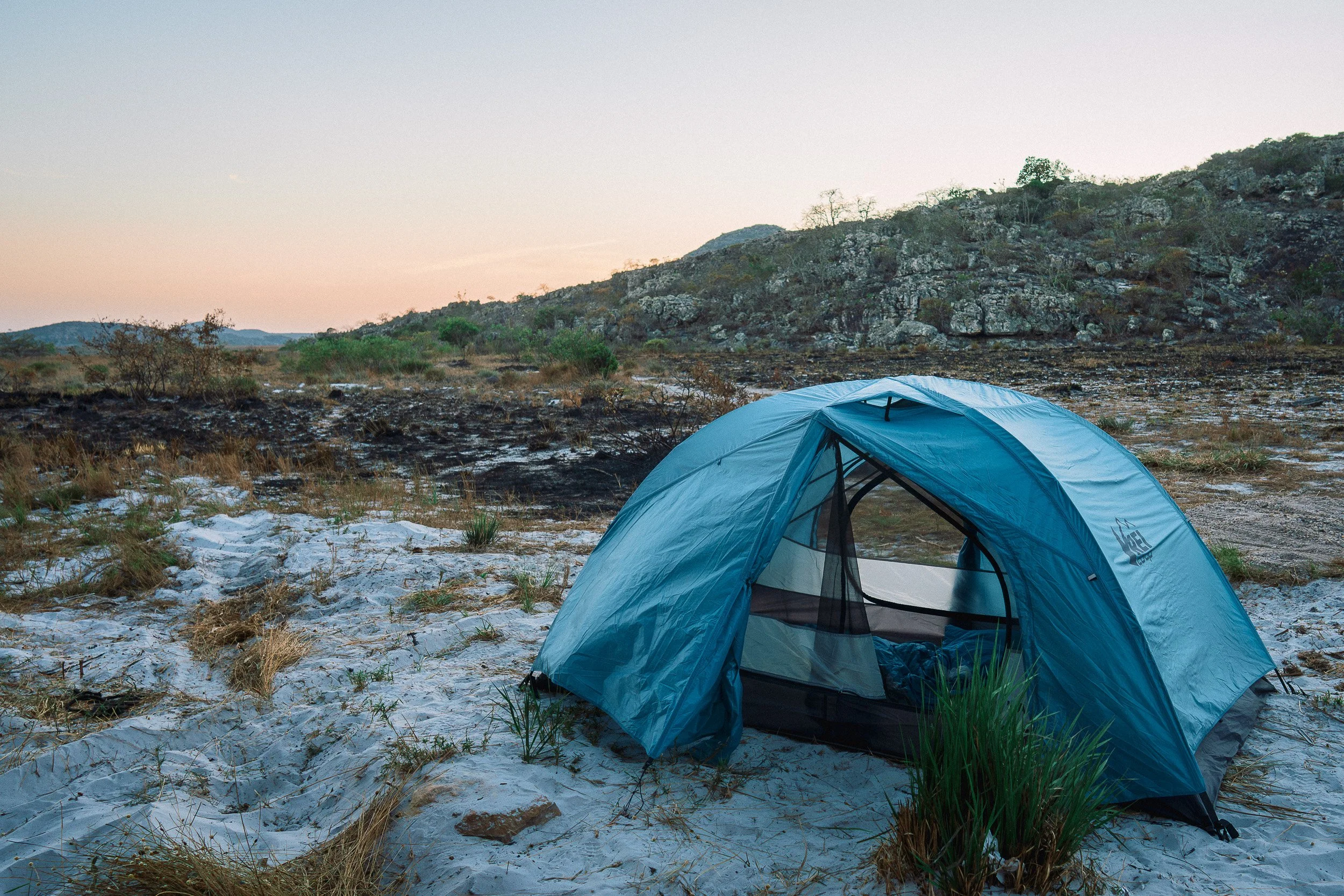
Sunrise.
Campos Tristes, Day 6
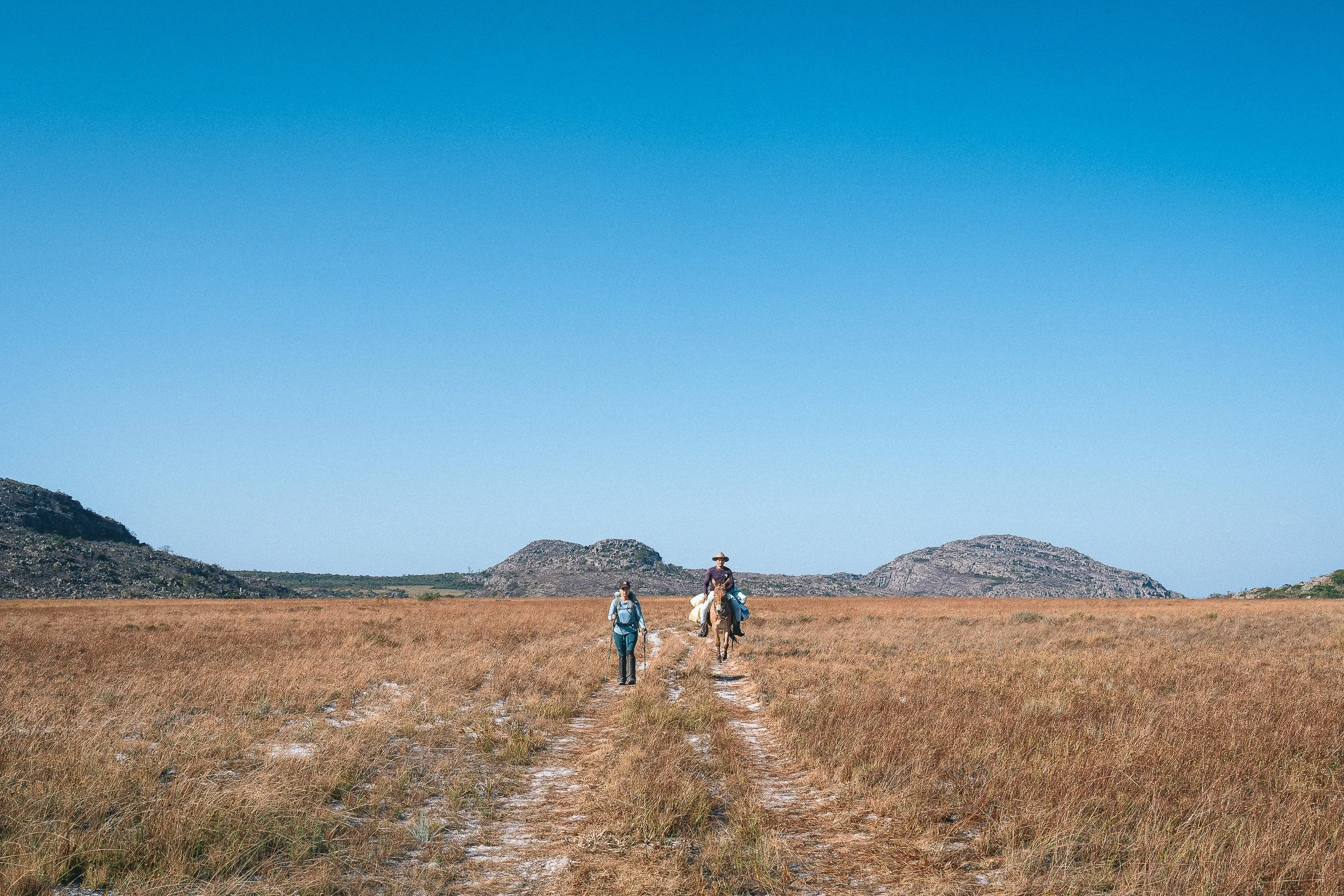
On the trail
Campos Tristes, Day 6
VII.
Journey to The Forest of Mordor
I’ve spilled more words in getting to this point of the Journal (and our journey) than I possibly imagined, so I feel as though a bit of strategic compression is in order.
The next morning (the sixth day of our trip), we gathered our things, bid adieu to Leandro et al., and headed north towards Campos João Alves. This was the historic “trail” through the center of the Park that Elisa and I had never done—the one we’d explicitly come to walk and document, and the one that Moises and I had talked through the night about at his home in Pé de Serra. I’d done a 6-km stretch of it with Júlio in 2022 (remember The Forest?), but that represented just a third of the line Elisa had mapped out for us today.
We’d deduced from our many conversations with residents from the surrounding communities over the years that few people had traveled this route in the past 25 years—a theory we were finding more evidence of during this field trip. Guim was 12 when he last traveled it with Moises. Alves (who knows Geraldo, but hadn’t seen him in many years) couldn’t remember the last time he’d walked it. Leandro wasn’t even aware of the trail’s existence, despite having rented the flower-picking rights of Campos Tristes for the past 6 years. (Importantly, he did say that he had seen a man on horseback ride in that direction at some point in the past few years. Important because it gave us hope that the trail would be somewhat clean. That hope was crushed).
The first 6 kilometers (which I had done) were amazing: blue skies, straw-colored grass, crimson and cream flowers, the mountains all around us, and an open double-track trail. Just beyond it: the apertado—a narrow passage between the mountains that descends sharply into a very different landscape, where steep walls and scorched earth (Leandro’s work) collide with willowy palms, saturated wetlands, and a tea-colored river, backdropped by distant mountains and valleys.
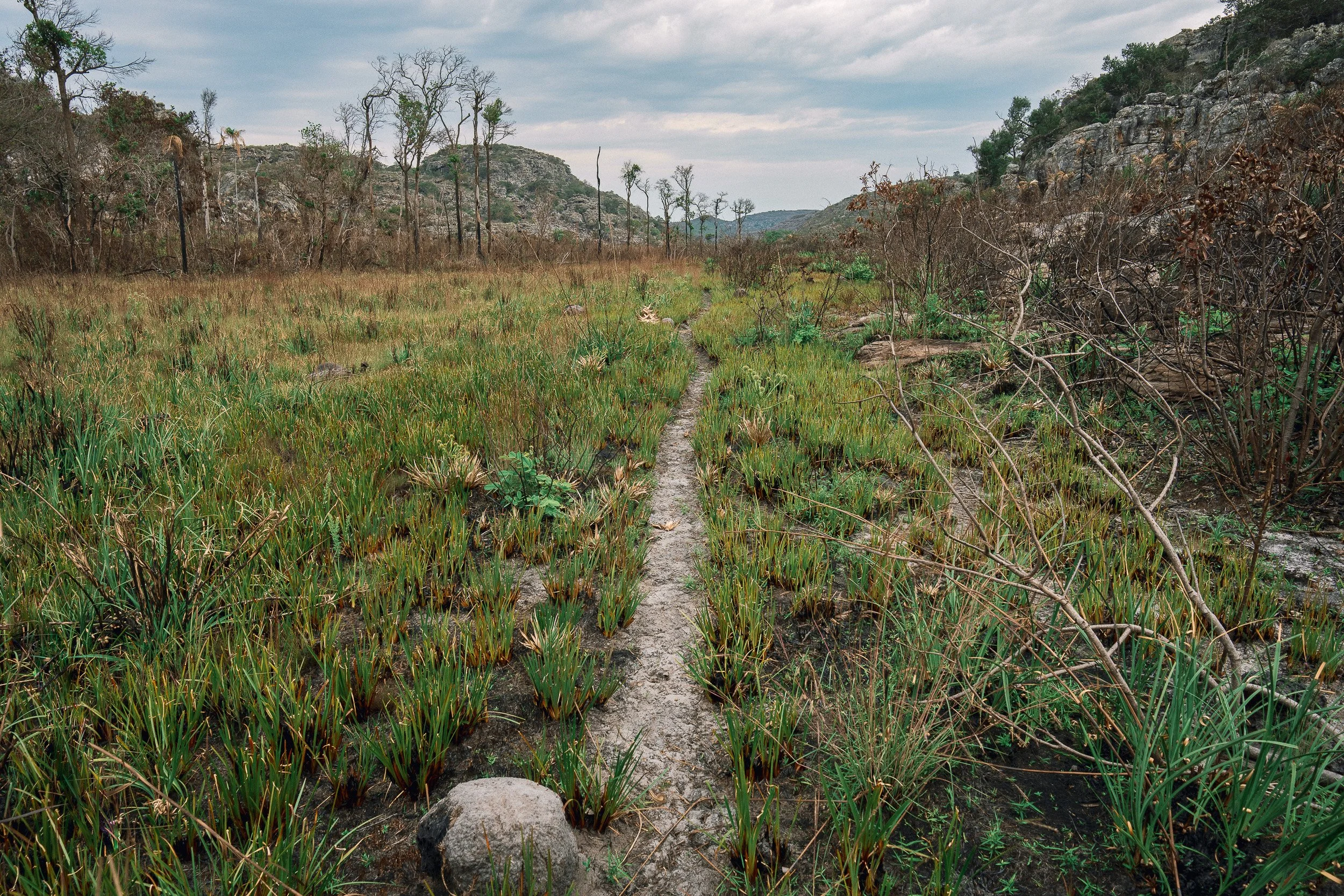
As we descended the apertado into this new world, a flood of memories—and an acute sense of dread—came over me. The Forest was now visible, and we were heading straight for it. (I should mention that Elisa and I had debated for days whether the trail she’d drawn on the map would pass through The Forest. She insisted that it wouldn’t, and Guim and Moises had also assured me... though less than convincingly. It seemed to me that in their minds, there were two forests that may have resembled one another, and they weren’t quite sure which of the two I had crossed.)
To my extreme relief, just as we were about to descend into what I believed was the most dreaded place in the Park, our trail broke to the right and followed the river. We crossed it, waded through the wetlands, and suddenly found ourselves in a place that was completely unfamiliar to me. New territory! (two of my favorite words as a guide).
But then we descended into a forest. It was, perhaps, the same forest. Perhaps it was a different one. It didn’t matter much: the experience was close enough. The difference now was that we’d come prepared—with multiple machetes, snake gaiters, permethrin—and that we had Baiana.
It took us three hours to descend 1.5 km through the forest (I don’t remember its locally given name, but at some point Guim, Elisa, and I began calling it a Mata do Mordor—the Forest of Mordor—and that’s how it has remained on our map and in our minds). We’d entered when the sun was at its highest and emerged on the other side, sweaty, exhausted, bloody (at least I was), and elated at 3 p.m.. In between those hours, we’d baked.
The sailing had been relatively smooth in the early going. Tight, but navigable. At around the midpoint, however, the game changed: all signs of passage disappeared, enormous fallen trees blocked way after way, and the forest became a close-quartered knot.
It was a cathartic experience for our group. The very best kind of perrengue: exhausting and exhilarating, but never truly threatening. We slashed, stomped, laughed, despaired, collapsed onto the dirt, and picked ourselves back up again together, and came out on the other side a tighter crew for having done so. Perhaps relatedly: I have no Sony photographs to show—only wild and foggy (fingerprint smeared) iPhone videos.
Rather than stop to eat, we decided to get as far away as we could. We walked another 3 kilometers along overgrown paths, head-high grass, and the occasional turfeira. At around 4 p.m., the sound of running water lured us off trail, and there it was: the Jequitaí. We threw off our packs and collapsed on a small patch of white sand, partially shaded by trees. Elisa and Guim ate. I smoked 2 (or 3?) palheiros. We drank as much water as our bellies could handle.
And then we continued north.
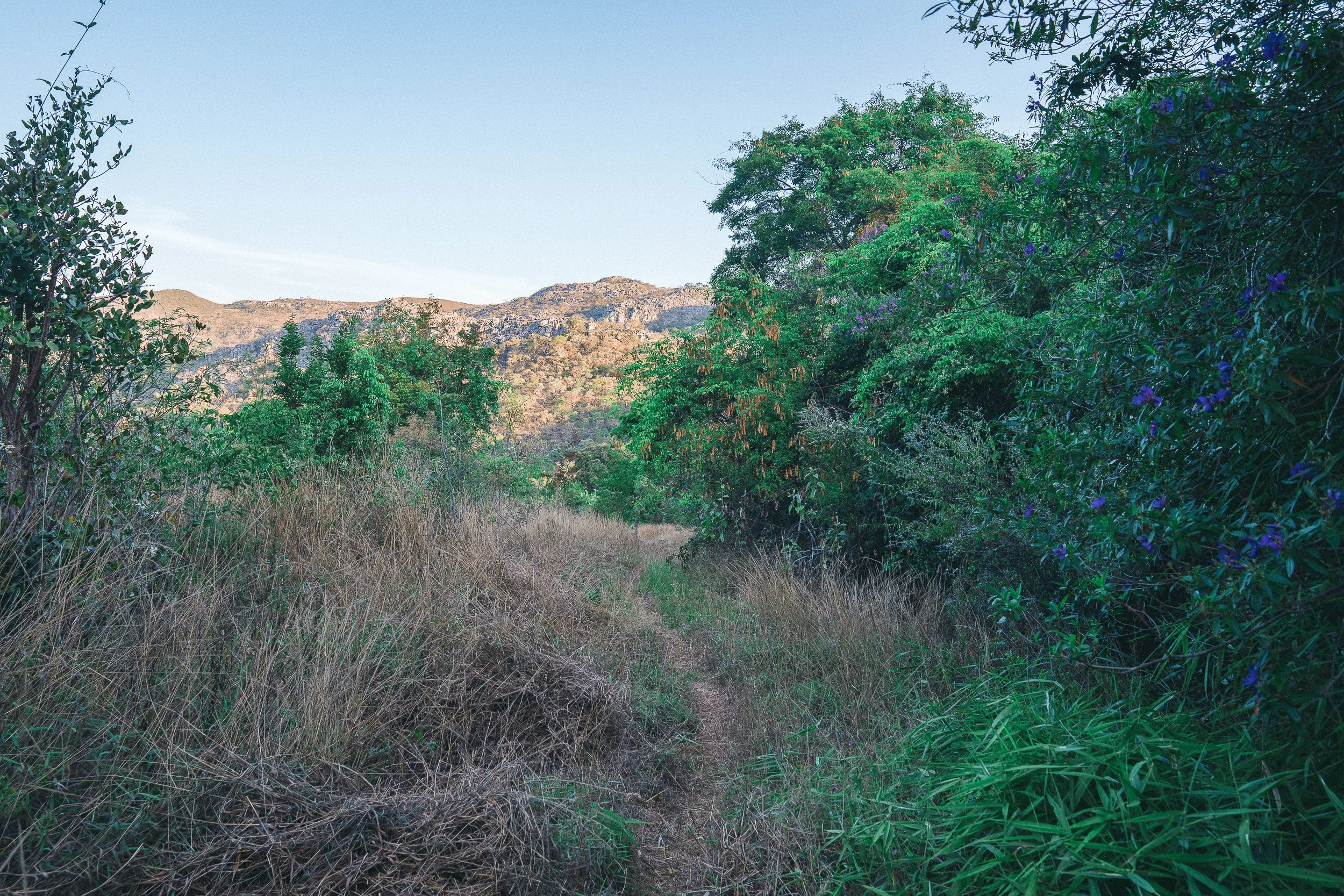
The old telegraph trail
Folheta, Day 6
VIII.
Folheta
We arrived at the junction between the trail we were on and the old, more consolidated Telegraph Line just as the sun was beginning to set.
From there, it was a straight shot down a forested tunnel along a wide dirt path to Folheta, a secluded valley paradise situated at the foot of Campos João Alves that Geraldo’s wife Neura tends to periodically.
In my experience, it doesn’t matter which direction you come from—whether from the Inhacica wetlands to the east, the tangled forests of Taquaral to the south, or—in our case—from the sertão to the west—the sight of the old sítio in Folheta always brings relief. A sprawling grove of banana marks the entrance to the former homestead, with mango trees, papaya trees, and orange trees appearing shortly thereafter. Suddenly the old home itself appears: small, rustic, and (recently) roofed. Signs of life.
Fresh water from a nearby creek courses twenty-four hours a day through a series of pumps and jerry-rigged hoses, spraying rhythmically and gently into long dirt channels between rows of green onions and collard greens and mandioca that Neura tends to weekly during flower season and daily during the offseason.
Elisa and I had just been here in July with the kids. The four of us had come up from the east with Gomercindo and Esdra and spent a pair of nights camped out in a dirt clearing 15 meters from the house. We’d made the clearing ourselves during that trip (Neura later commented how nice it was; prior to that, we’d pitched tents in various other parts of the property in situations that left much to be desired), cleaning and leveling spots for a pair of tents, repositioning logs for benches, and building a proper fire ring nearby.
Everything was as we had left it. Elisa took a bath in the nearby creek and began setting up the tents, Guim tended to Baiana and gathered firewood, and I prepped dinner. Neura had invited us to use the wood-fired stove located outside the house during our last visit (she also warned us to be careful around the house because of snakes), and I planned on taking full advantage of it during the next few days.
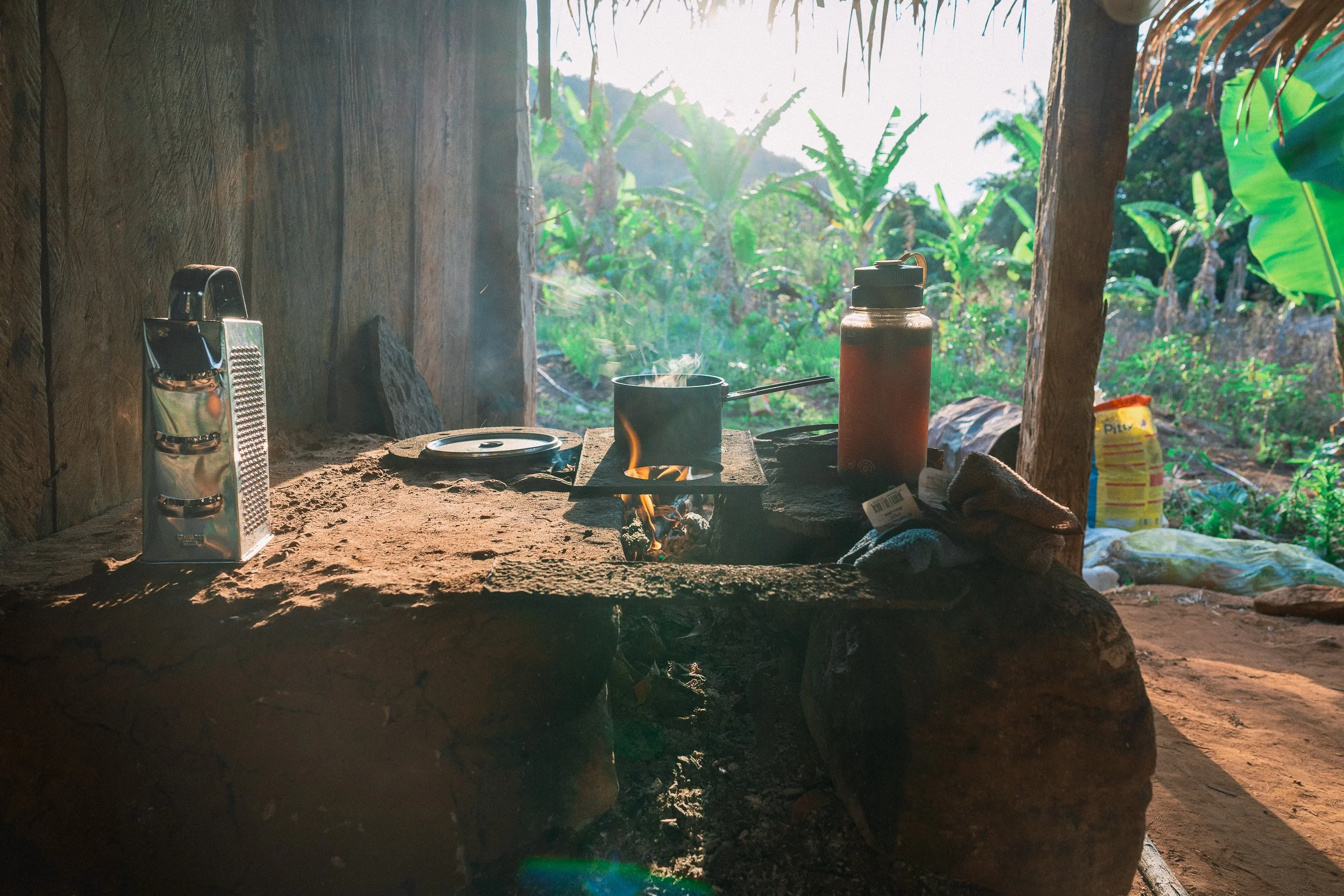
Tonight’s meal would be quick, easy, and highly caloric: I’d made a pesto at our house in São Gonçalo before setting out on the trip and sealed it tightly in a glass jar, knowing that Baiana would be able to carry it in for us. It took all of about 20 minutes to plate and left all of us satisfied. (I’d worried Guim might not like it due to the copious amounts of garlic, but he gave it a nota dez which, I have to say, meant quite a lot coming from him—he’d told us before the trip that he’d never eaten a foreign dish before, and between his reactions to the pesto and the mujadara the night before, I was both delighted by his open mind and feeling pretty good about my camp kitchen skills).
After dinner and another lidful or two of cachaçinha, Elisa turned in and Guim and I headed over to the fire ring. I made a small fire that he promptly turned into an enormous bonfire, and we sat there mostly quietly, admiring our new surroundings. He taught me about the moon’s patterns (something I’ve never been able to quite grasp) and the southern hemisphere night sky.
He’d never been to Folheta before and was liking it very much. The valley is wild and isolated, but between the fruit trees and roof and fire, it’s as close to home away from home as this part of the range gets.
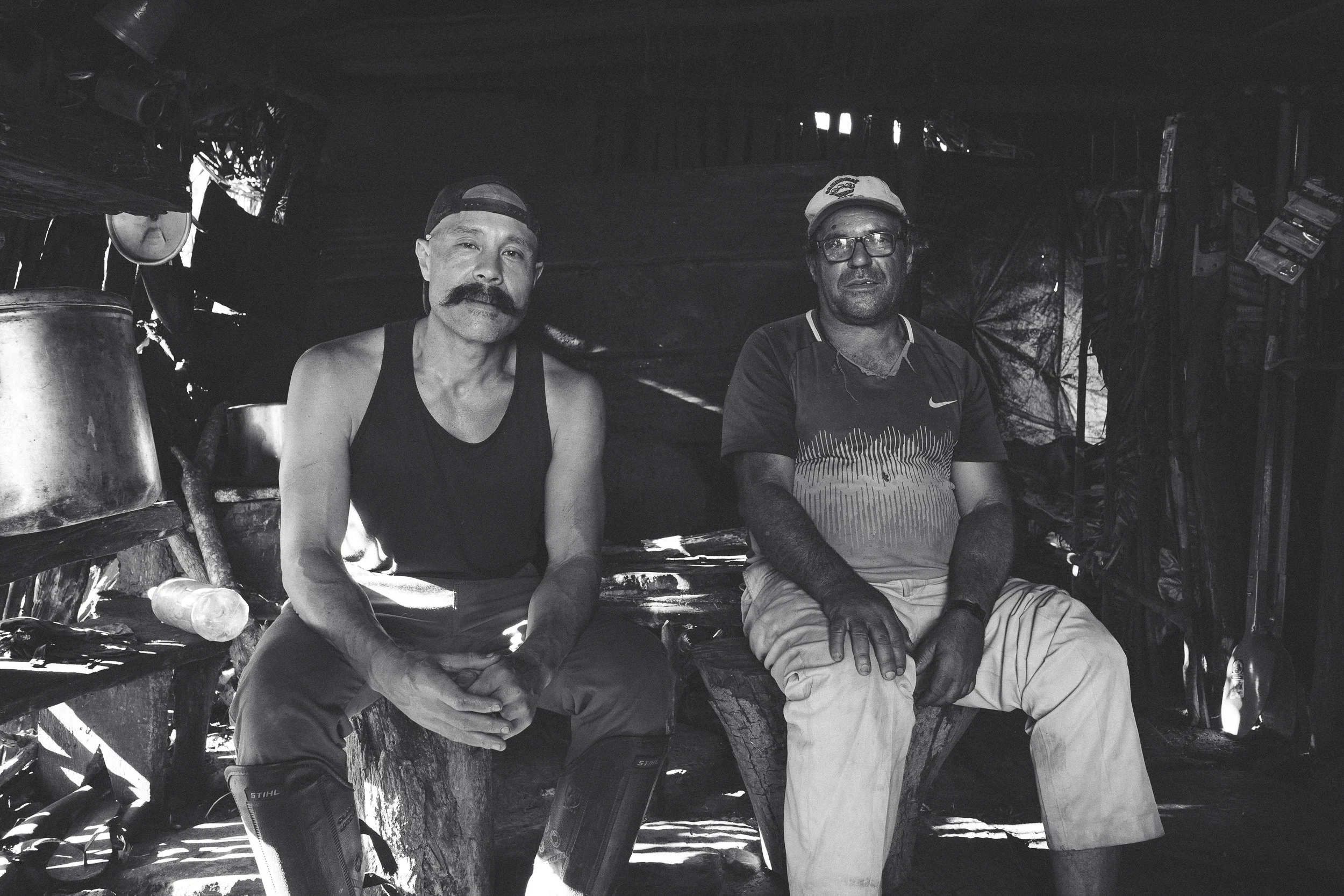
Student & Mestre
Campos João Alves, Day 7
IX.
Alone time | Geraldo | 3 days between Folheta & Campos João Alves | Flowers, Philosophy, History & the future
We’d come to document the oral histories of Geraldo and his family. Today—the seventh day since Elisa and I had left São Gonçalo—would be the first day of that endeavor.
I’d been a bit nervous about the event ever since Elisa managed to connect the logistical dots to make this field trip possible. Over the years, I’d informally interviewed hundreds if not thousands of people about their lives, of course (it comes with the territory; but also, if I weren’t insatiably curious, I would never have chosen this path for my life). I’d also been the subject of interviews before—including one that had been quite intimate and had had real implications for my family and me—but I’d never proposed one that felt so consequential.
Geraldo’s story was unique, and my respect for him made the prospect more daunting. It felt important. And it felt delicate.
Until Folheta, the encounters with Moises, Alves, and Leandro—and the caves, the trail, the Forest—had kept the looming conversation out of my mind.
Now I had to figure out how to begin.
——————-
Guim and Baiana left shortly after breakfast.
Guim didn’t eat much: coffee with powdered milk and sugar, and little else. He was hoping to make it all the way back to Pé de Serra today, arriving by sundown, and I didn’t doubt that he would—especially given how little weight Baiana would now be carrying (more on that in a bit).
We said goodbye, nostalgically (it’s truly amazing how the trail can bring people together; just 60 hours earlier, we were strangers) but also reassured that we would all be reuniting at his home in Pé de Serra in just four nights’ time.
Once they’d left, Elisa and I took our time at breakfast. Cheese (of which we’d brought way too much—2 kilos!), granola, oatmeal, powdered milk, coffee, and lots and lots of water. We weren’t in a rush. From our campsite, Campos João Alves was just 4 km away. Four vertical kilometers, but just 4 km.
It was exciting to be there with just Elisa. It dawned on us both that it had been a surprisingly long time since the two of us had been so far from civilization together without anyone else (to be fair: in the Espinhaço, you can really only be this far from civilization in the heart of Sempre Vivas, and most of our trips in this part of the park involve clients, locals from the surrounding communities like Guim, or both).
Of course, Geraldo and his family were just up the mountain from us, but we hadn’t seen them yet. And Folheta, where it is known at all, is known for its active wildlife.
We’d be camping here for the next two nights, making the round-trip to Campos João Alves the next two days. Then, the plan went, we’d head back to Campos Tristes to Leandro’s cave and onward to Pé de Serra, probably arriving after sundown.
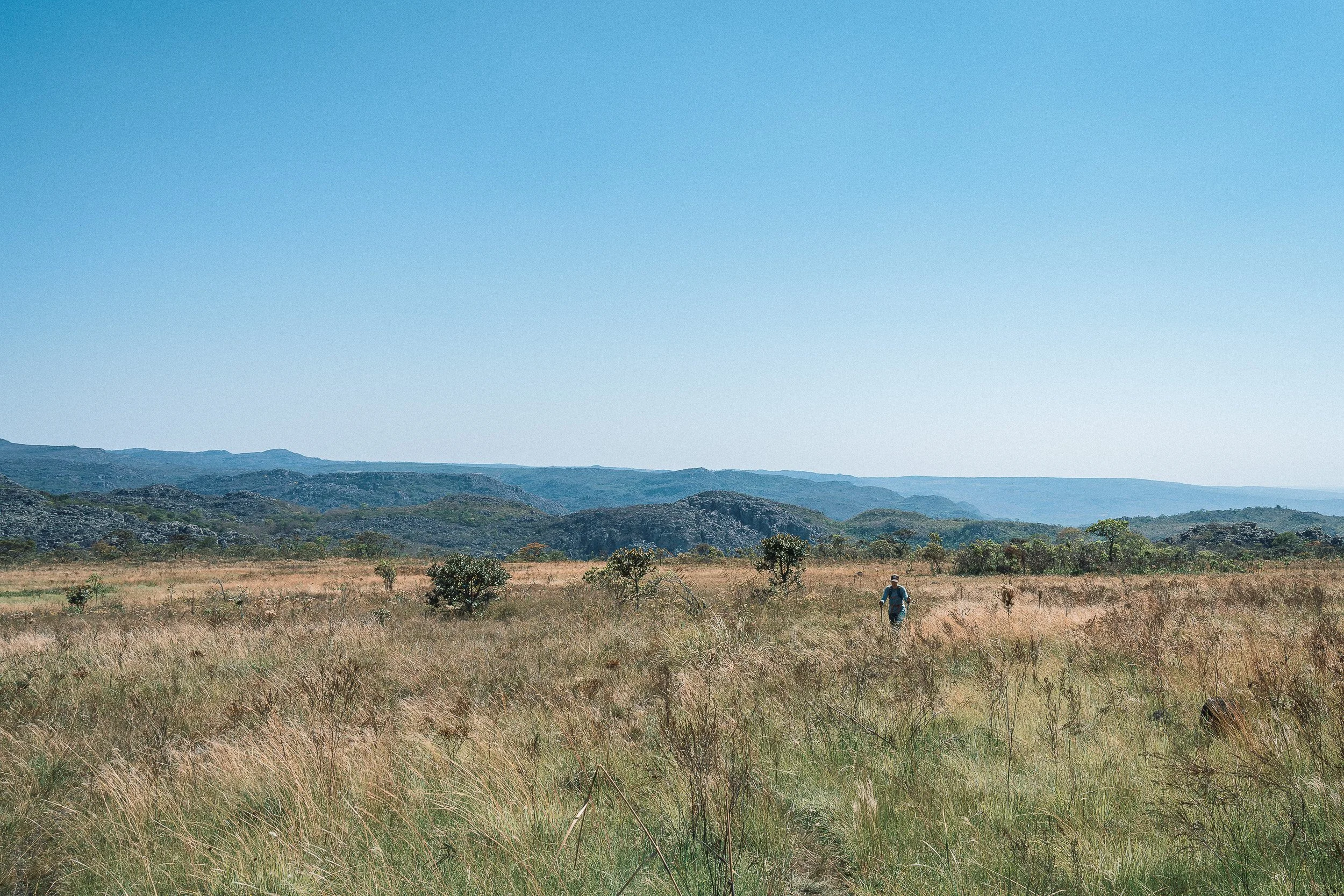
The walk from Folheta to Campos João Alves is, to borrow a particularly apt word from Portuguese, deslumbrante.
An unrelenting but gorgeous 4-km ascent along a constantly shifting historic path that begins at a romantic (but dicey) footbridge and winds upwards through an assortment of cerrado vegetation and vista-blessed mountainsides before descending gently into a vast and flowing field of grass and flowers.
The trail is short, but dazzling. If you have a camera (or a phone; we had both—and a drone), it can take hours.
Geraldo’s house is tucked neatly on a windswept hillside just beyond a small stream, shaded by fruit trees. When we arrived, Deivid had just come back from the fields. It was genuinely good to see them again, and they welcomed us in and asked how the journey had been. We told them the story—the dusty roads, the council meeting, the caves, the forest—sent hugs from Alves, and drank coffee as we unpacked the gear: the Sony, the iPhones, the microphones, the tripod. It was friendly but also in my mind a bit awkward, this slow dance of “getting to business”.
As Elisa began setting up the shoot—positioning the tripod here and there, moving chairs (heavy tree stumps) around, studying the light (there are no windows in the home—light enters through the thin wooden branches that comprise the walls in places, and where tarps allow in others)—I feebly reminded us all that we had come to make good on our promise in July to document their histories. That is to say: to document whatever it was that they wanted to have documented. Geraldo and Deivid nodded solemnly in agreement.
And then we began.
What did we talk about?
Well, a lot frankly. I could write about it for days (I think I’ve proven as much in this account). Over the course of two full afternoons and a pair of 128-GB memory cards, Geraldo and I sat side-by-side on a pair of tree stumps in front of his wood-fired stove, less than an arm’s length from one another, and talked about subjects ranging from his family’s history in the region to his household’s fascinating religious beliefs; from the business of flower-picking to his unique perspectives on the National Park and the prospects of tourism.
Occasionally—especially on camera—the conversation was structured and thoughtful, Geraldo calculated in his words. At other times—especially off camera—the conversation was deeper and more reflective, questions leading to stories that revealed profound values.
At one point off-camera, he began talking through the finer points of Aramaic philosophy—a delightful detour that prompted the following exchange: “Geraldo, I’ve been to your hometown (a rural flower-picker village called Galheiros, with a population in the dozens) and spent evenings drinking beer and rubbing shoulders with people at Zé’s pub. No one there is talking about Aramaic philosophy. They’re talking about futebol and Lula and Bolsonaro. Where did this curiosity in you come from? What sparked your interest? What made you you?”
At some point down the road, when Elisa and my work schedule allows, I’ll dive into the archives of my conversation with Geraldo and, with his permission) publish the answers he was willing to give.
As for what made Geraldo—the man from Galheiros—into “Geraldo da Serra”, I’m afraid that’s not my story to share.
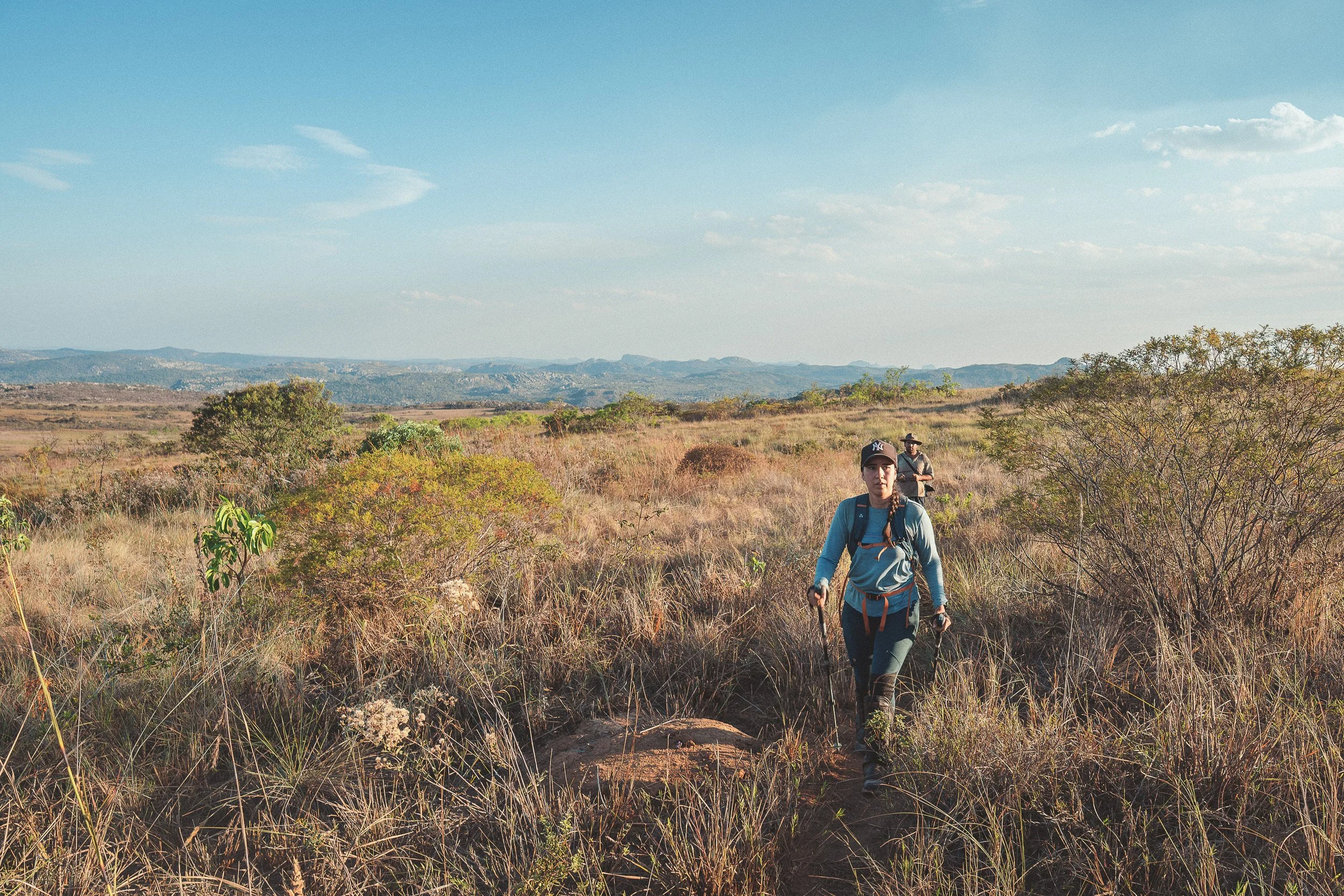
Going back to Folheta.
Campos João Alves, Day 8
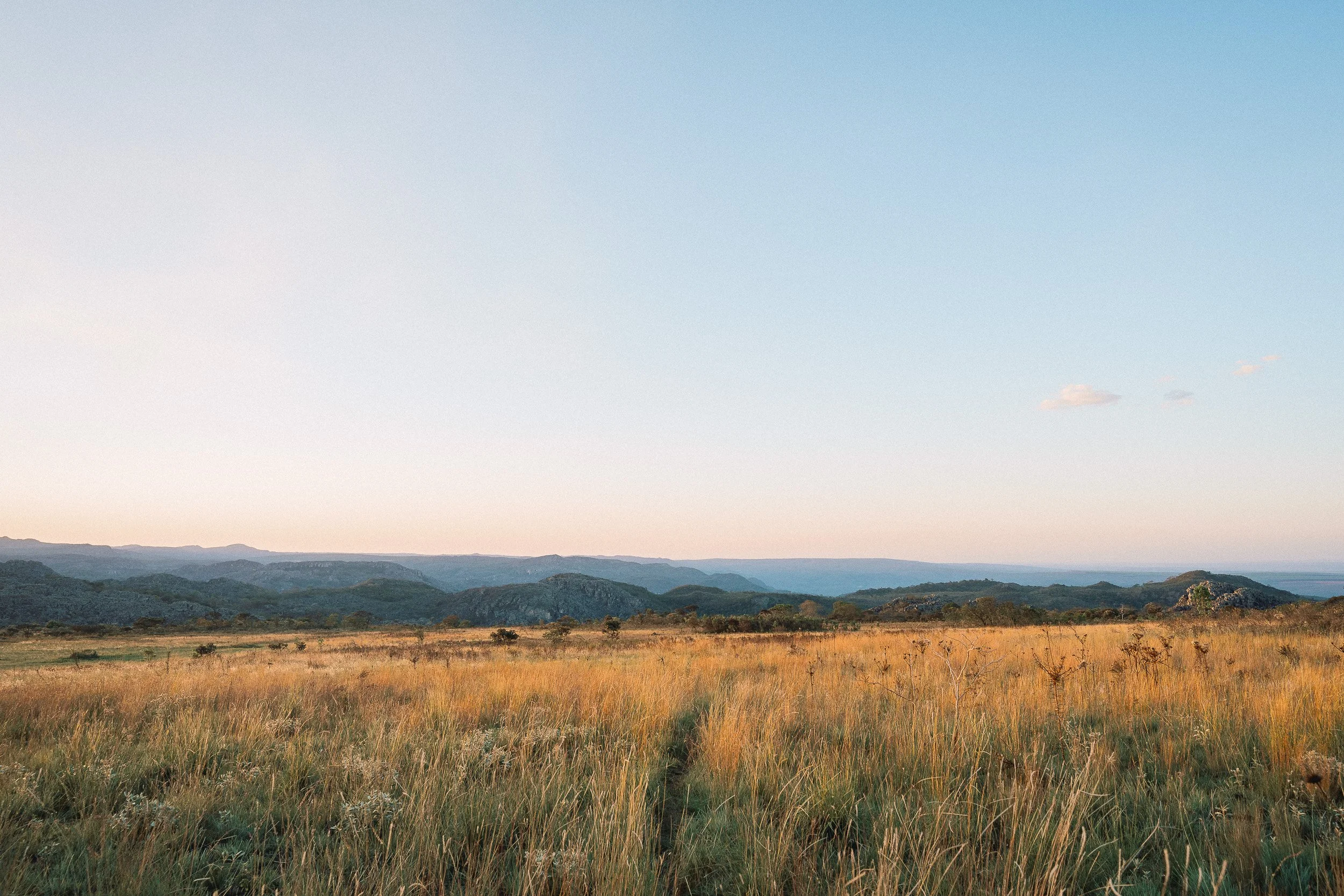
Perfect 10.
Campos João Alves, Day 8
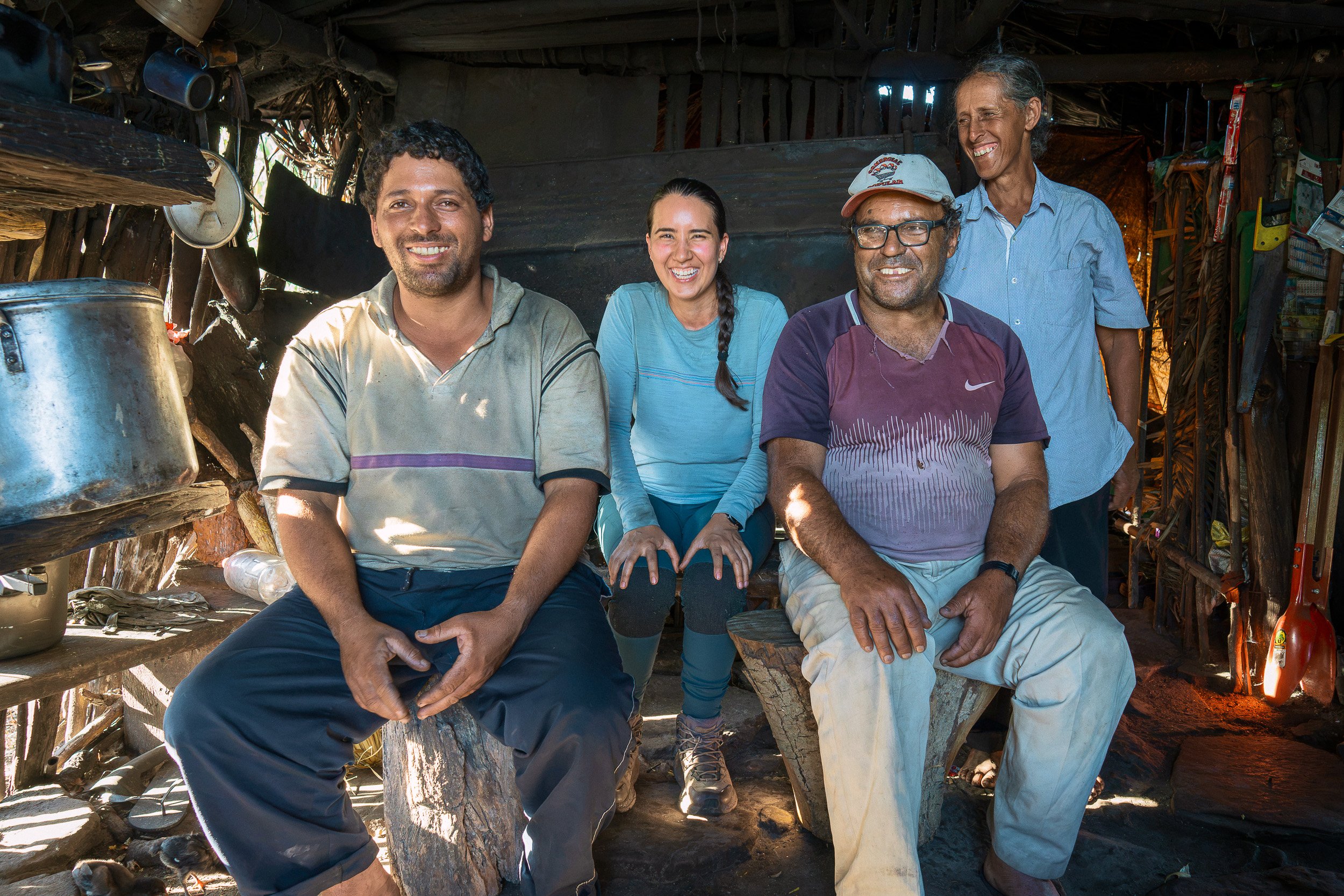
Group laugh!
Day 9
X.
Neura | A Long Good-bye | Heavy Packs | The Journey Back to Campos Tristes
By golden hour of Day 8, the interviews had ended.
To all of our great pleasures, Neura showed up during both afternoons just as the interviews for the day were wrapping up. Her presence was much more than token; it brought lightness and warmth to both evenings.
Elisa and I had stayed for dinner and music on Day 7—Geraldo had killed a chicken (something Deivid told us he never did; the chickens were raised and periodically sent to market in Senador Mourão, a day’s journey for Deivid on motorcycle, foot, and canoe), and as he prepared it in the dark on the wood-fired stove alongside rice and beans, kerosene lamps and flashlights (and medicinal cachaça!) came out, and Deivid and Neura passed around the accordion and sang.
It was such a privilege to be able to put the cameras down and spend real, non-work time with the family in their home. Between our fleeting visit during Field Trip no. 3 in 2022, our longer (but still brief) visit with Luca and Tiago during Field Trip no. 13, and especially this one—in which we’d learned so much about one another in such a short amount of time—we’d become increasingly comfortable around one another. (It should also be said that the dinner was delicious!)
After our interviews and a bit of celebratory music (including an unexpected guitar cameo) on Day 8, though, Elisa and I politely declined the invitation. The descent to Folheta was long, and we wanted to get back to organize our things as much as possible ahead of the long journey back to Campos Tristes in the morning.
We agreed that we would need to visit again and soon, after the summer rains but before our guiding season started in 2027. The next time, we promised, we’d stay at their home as opposed to Folheta (though Neura is angling to move the family to the valley full-time during the offseason to be closer to their food source).
In an important bit of work-related news, the family said they’d welcome us bringing travelers with us during trips, and would be honored to cook dinner with advance notice.
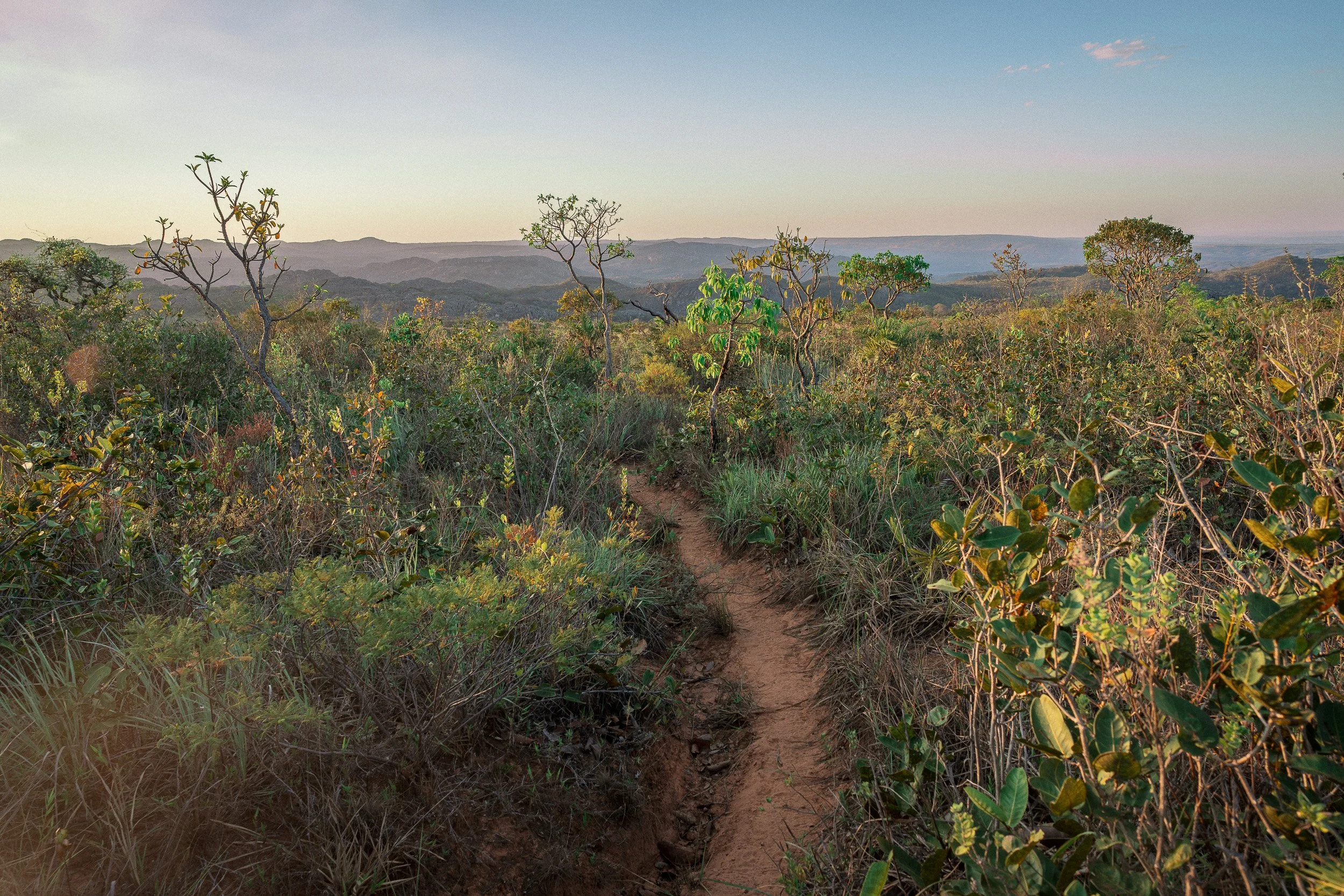
Our descent to Folheta on Day 7 had been in the dark, tipsy (from the cachaça), by headlamp. On Day 8, it was the stuff of high savannah dreams: a bona fide carousel of lush, golden hour mountain vistas.
We cooked and ate quickly, organized what we could, chopped wood and got a fire going, and slept early.
Following breakfast (in which we consumed as much cheese as humanly possible) on the morning of Day 9, we realized that we had simultaneously overcalculated our food rations for the remainder of the trip, underestimated the weight of the photography and video equipment (read: drone batteries), and overestimated both the volume and carrying capacities of our packs. Between the food, electronics, and our regular camp gear, as well as the extra bushwhacking, communications, and first-aid equipment specific to a week in this part of the park, our 120–140 liters of combined pack volume weren’t nearly enough space—to say nothing of the weight.
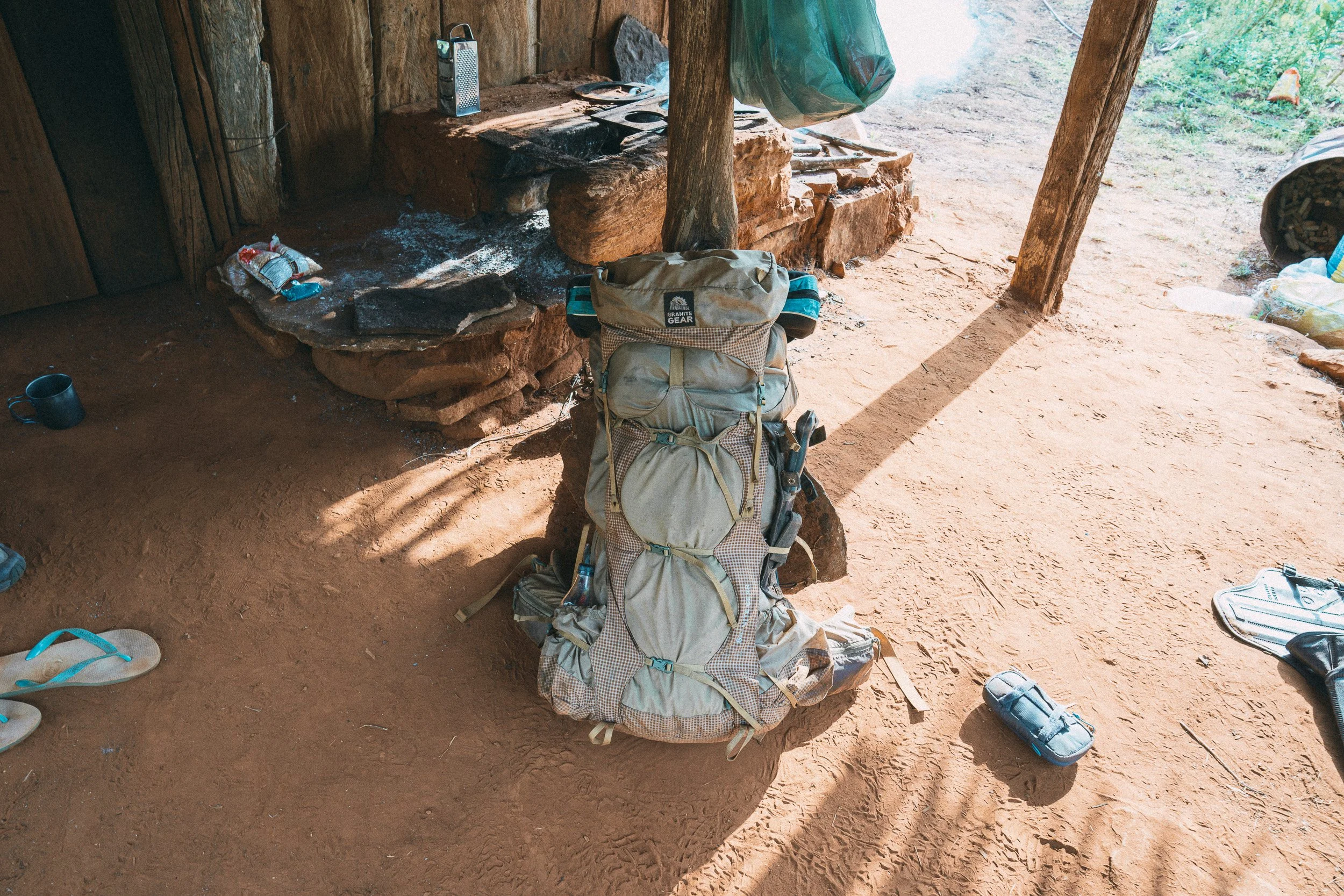
We decided to donate the heaviest food items (except, for some reason, the remaining kilo or so of cheese) to the family, and the hatchet and rope and a few other items to Folheta. Even so, my Granite Gear 60 was bursting at the seams and weighed right on the edge between “We may want to eat a bit more of the cheese” and “We may need to radio Baiana.”
Oh well. What’s a journey without struggle?
I won’t go into too much detail about the trek back to Campos Tristes.
It was gorgeous. It was exhausting. It was exhilarating. Our lone, constant concern the whole day was Mordor. We pushed the pace surprisingly well, arriving at noon, with plenty of daylight peering through the trees. The bush on both ends of the forest was freshly cut/stomped, and while we did get a bit lost in the “knot” in the middle (where Guim and I had cut furiously in multiple directions, essentially opening up new false trails), Elisa had tracked our Day 6 line with the GPS, which prevented any serious detours.
That said, going up through the forest with a 60-lb pack was a quite different animal than going down it with a 25-lb one. When we finally emerged on the other side, about an hour and a half later, I was dead.
From there, we continued to make our way up, up, up, through the wetlands and the apertado, through the tall spiky grass, and finally onto the smooth fields and sandy double-track of Campos Tristes. When we were just a kilometer or so away from Leandro’s cave—so close we could make out the blue tarp of the kitchen flapping in the distance—I took my pack off (or maybe I kept it on?) and collapsed onto the sand with relief.
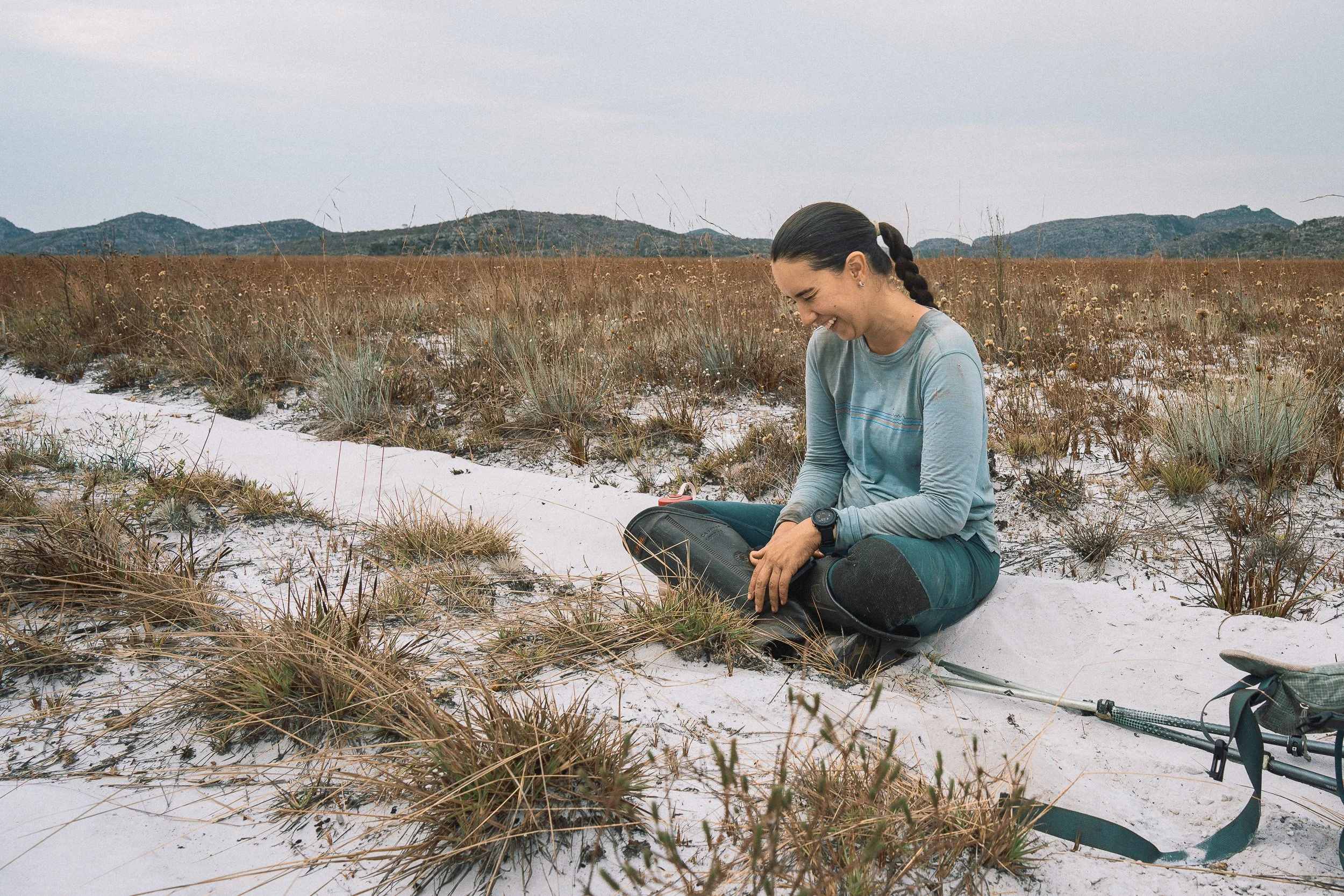
Elisa and I sat there for nearly an hour, laughing, taking photos of one another (apparently I was filthy), mindlessly playing with the flowers and grass. Exhausted. Elated. Safe. Together.
XI.
Reunions | The Journey back to Pé de Serra | Cervejinha
Our second night at Leandro’s cave was nearly as magical as the first one. Kerosene candles. Windswept kitchen tunnel. Wood-fired goodness. The last, precious lidfuls of cachaçinha. Water.
Unfortunately, Leandro himself wasn’t there when we arrived. He and Silvia had taken the pickup to the market in Diamantina to deliver dried flowers and bring back supplies. Gonçalo and Ronaldo welcomed us warmly in their stead and kept us great company, their long and peaceful silences between unforced words ever more comfortable. The symbolism of their relationship was not lost on me: father and son, working side by side in the fields, breaking bread around the fire, sleeping in the lapa by candle at night. A generations-old rite of passage.
That said, I was even more profoundly struck by the nature of their presence. Respectful, polite, generous, quiet, thoughtful. It all stood out against the fire. Even today, I find their humility has left a mark.
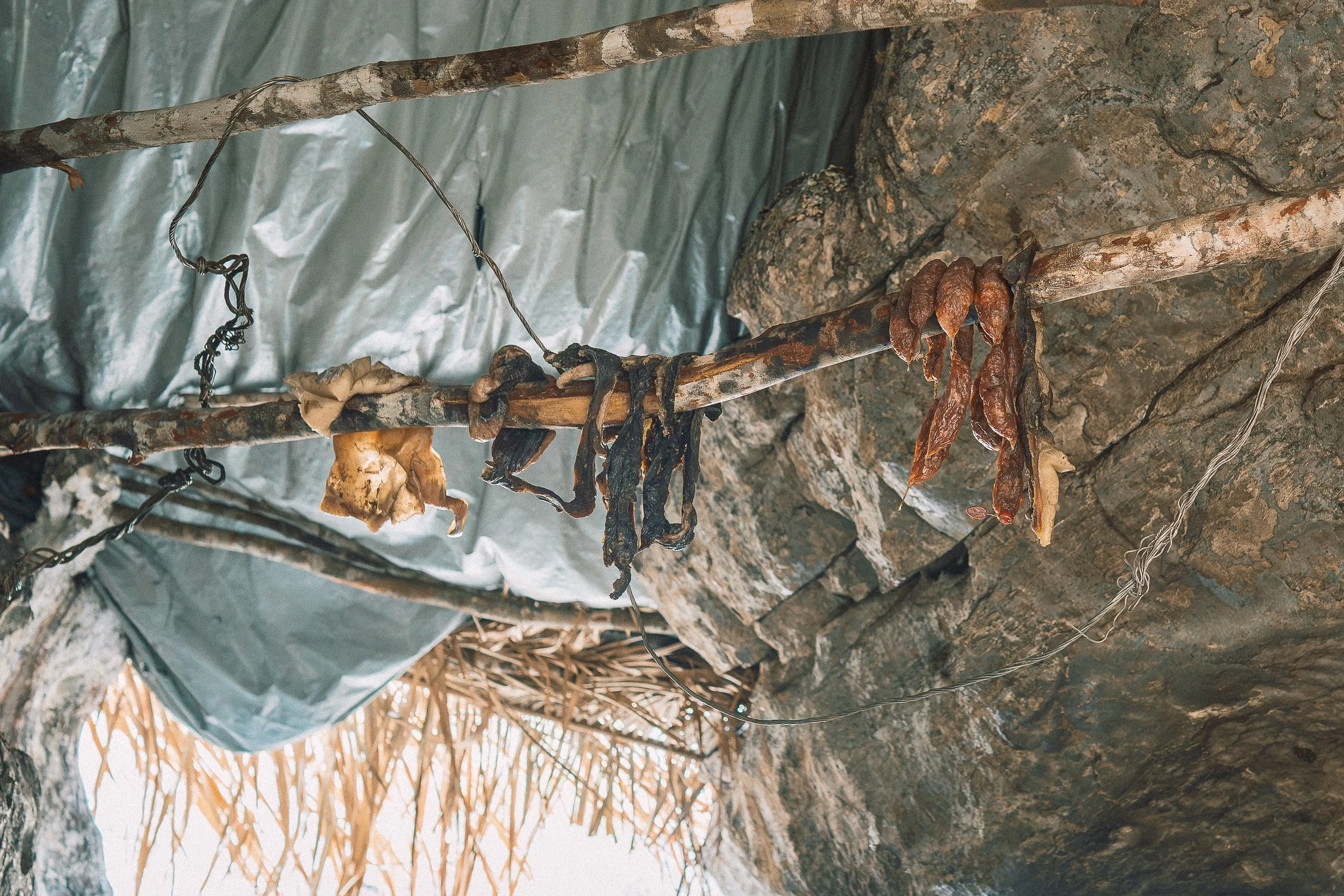
Leandro and Silvia showed up in the morning as we were preparing to leave and somehow managed to bake a cake in the wood fire before we’d set out (I’m still not quite sure how they did that). It was sensational. Elisa and I humbly donated the last of our cheese—half-eaten, sand-speckled, and generally a bit undesirable looking at this point—which Silvia received as though it were an heirloom.
There would be a party coming up in Capivarí (just 9 km on foot from our house in São Gonçalo) on October 12, and Elisa and I were planning on attending. So, too, were Leandro, Silvia, Gonçalo, and Ronaldo. We agreed to reconvene then, and invited them all to our home for dinner.
Eight difficult but prosperous weeks in the bush, followed by a weekend of dancing, fireworks, and cervejinha. It sounded like a good plan.
In fact, it sounded a bit like our own plan for the day.
Pé de Serra was now just 16 open kilometers away, with no forest in between. Just six or so km of powder white sand to Alves’s cave, another three or so to the serra, and a final seven of rocky descents and river crossings. Elisa and I pulled our packs on, the absence of cheese, cachaça, and another night’s worth of pasta not necessarily noticeable, but welcome by our hips and backs nonetheless.
Gonçalo had mentioned a group of men riding by the cave that morning, headed to the weekend festivities in Curimataí no doubt. The wind in the campos made it tricky to follow tracks, especially during less consolidated parts of the trail. Besides, we weren’t heading to Curimataí, which would have pulled us farther south.
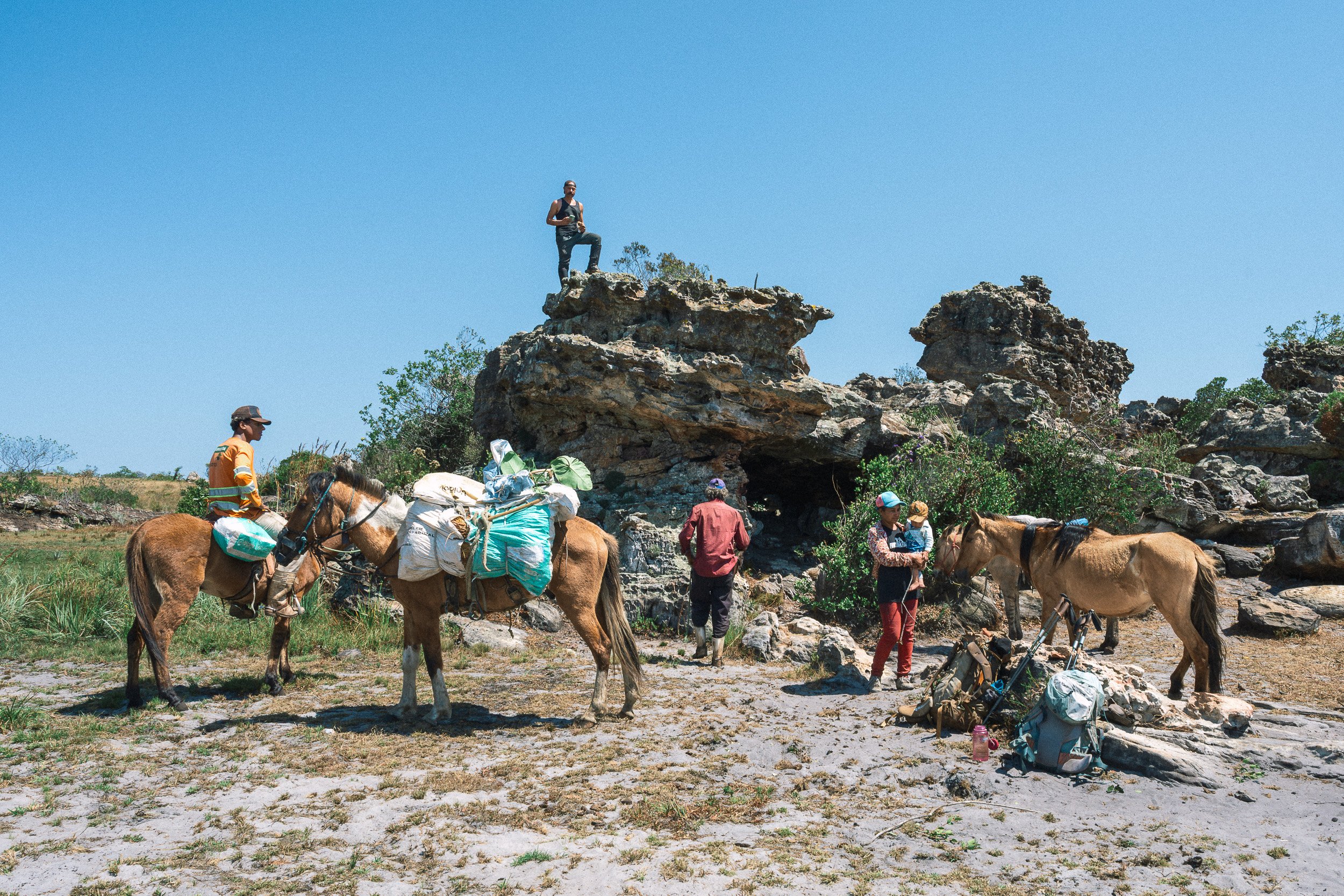
That said, as Alves’s cave came into view, we saw a number of horses and riders—and dogs—preparing to ride out. I had never seen so much traffic in the park. It was beginning to feel surreal.
It turned out to be Alves and his family, and as we arrived, they dismounted and greeted us excitedly. Guim and Baiana had passed by a few days before and told them we’d reached Campos João Alves and would be returning yesterday. It was a mixup, but the family had been worried, to the point that they’d delayed their return trip to Pé de Serra to make sure we were okay.
We were absolutely touched, but assured them we were fine, and that the journey had been incredible. Alves told us they’d left some fresh coffee in a thermos by the stove in the cave for us. They were sertão-bound—to deliver flowers to market, and to stay the weekend in town. We agreed to stop by and say hello before the party in Curimataí.
I had one final request: might I photograph and film the scene? He laughed loudly, shook his head amusedly and belted out his now trademark “Claaaro! Eddie, claaro!” (Alves is a veteran Tik-Tokker; it’s a long story!).
It was a beautiful scene. A beautiful landscape. A beautiful family.
And like that, they were gone and we were alone in the high campos again.
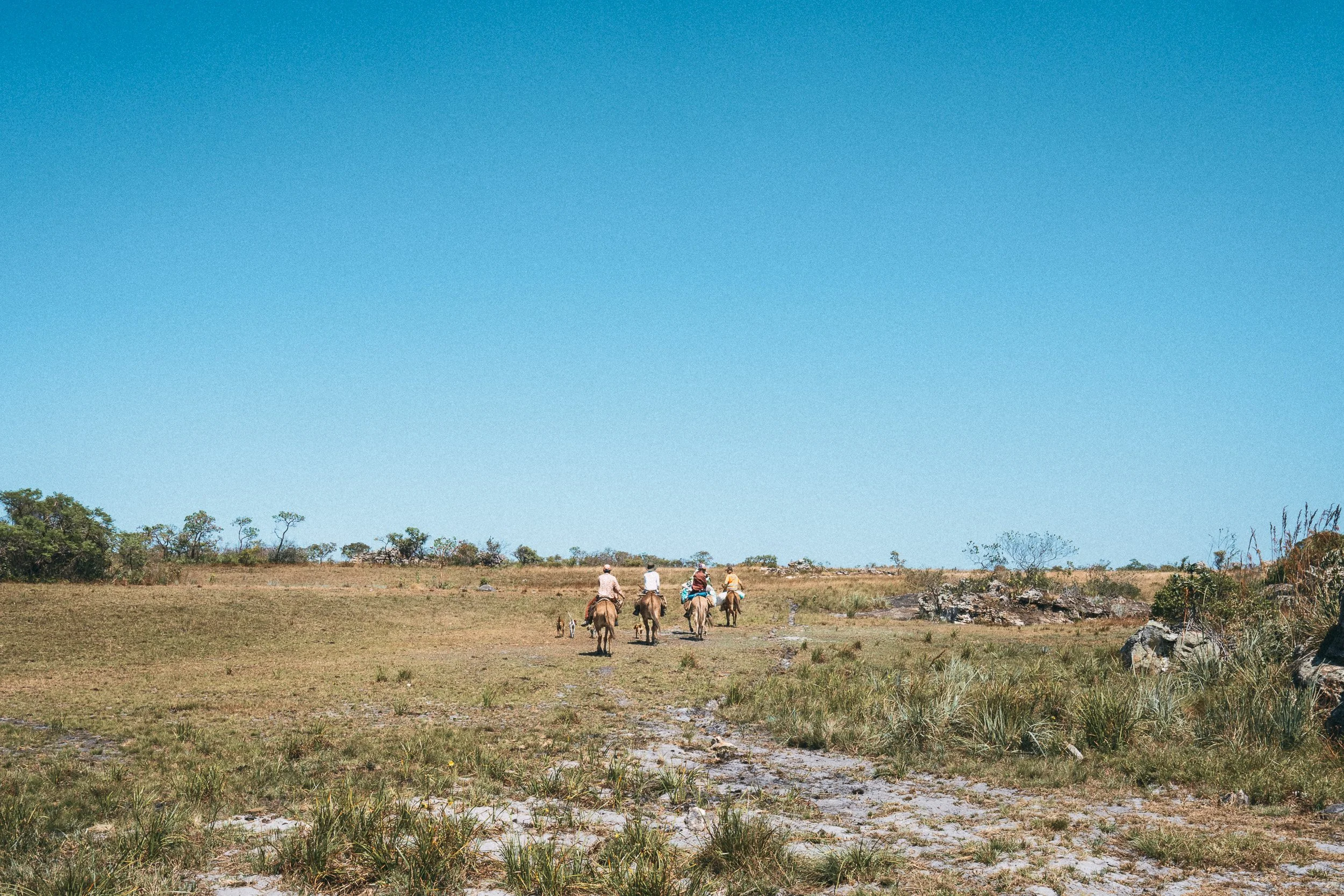
Even with the heat, lack of shade, and debilitating pack weights, the rest of the journey back to Pé de Serra was pure bliss. Not only was the constantly evolving landscape mesmerizing, the cerrado omnipresent, and the company unbeatable, the trail now had meaning. Guim had confirmed on the way up on Day 5 that just a handful of people—mostly relatives of his—still traveled these paths. We’d spent time with them, heard their stories.
Too often, the final kilometers of a long trek are carried by the promise of arrival. As Elisa and I made our way west through the winding serra, I wasn’t sure I even wanted to arrive. (If our cachaça hadn’t run dry and we hadn’t told Guim to expect us that evening, we would have made camp on one of the white sand beaches along the Jequitaí and then continued to Pé de Serra the following morning. It’s on our list.)
We took our time at the river, then rushed upward to catch golden hour at the top of the final descent. It was worth it.
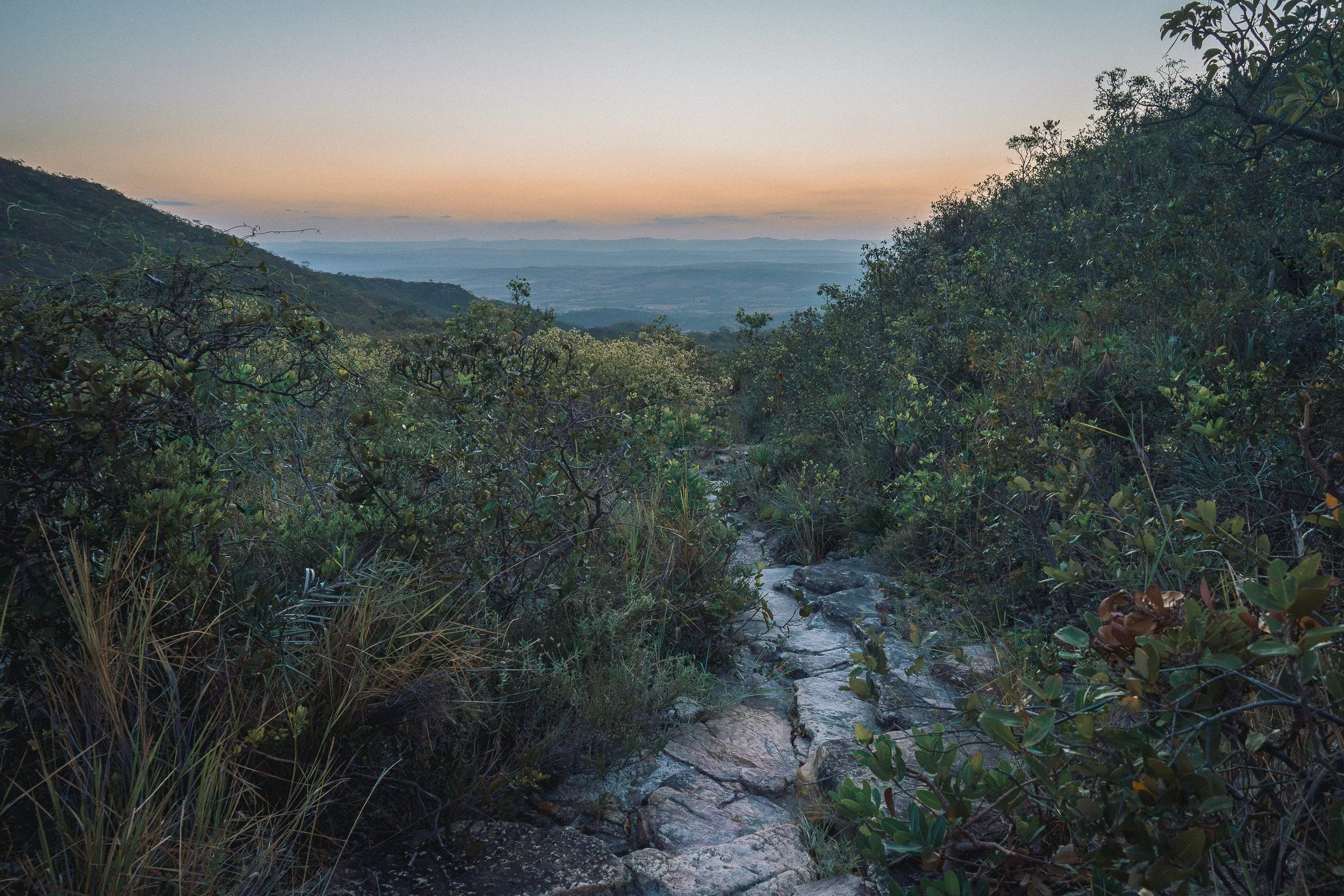
Elisa and I arrived at Guim and Moises’s house at around 8 p.m., well after the sun had set. The final kilometers had been unexpectedly brutal—headlamps, loose gravel, sweat, meandering cattle trails, complicated stream crossings—but they made this moment all the better.
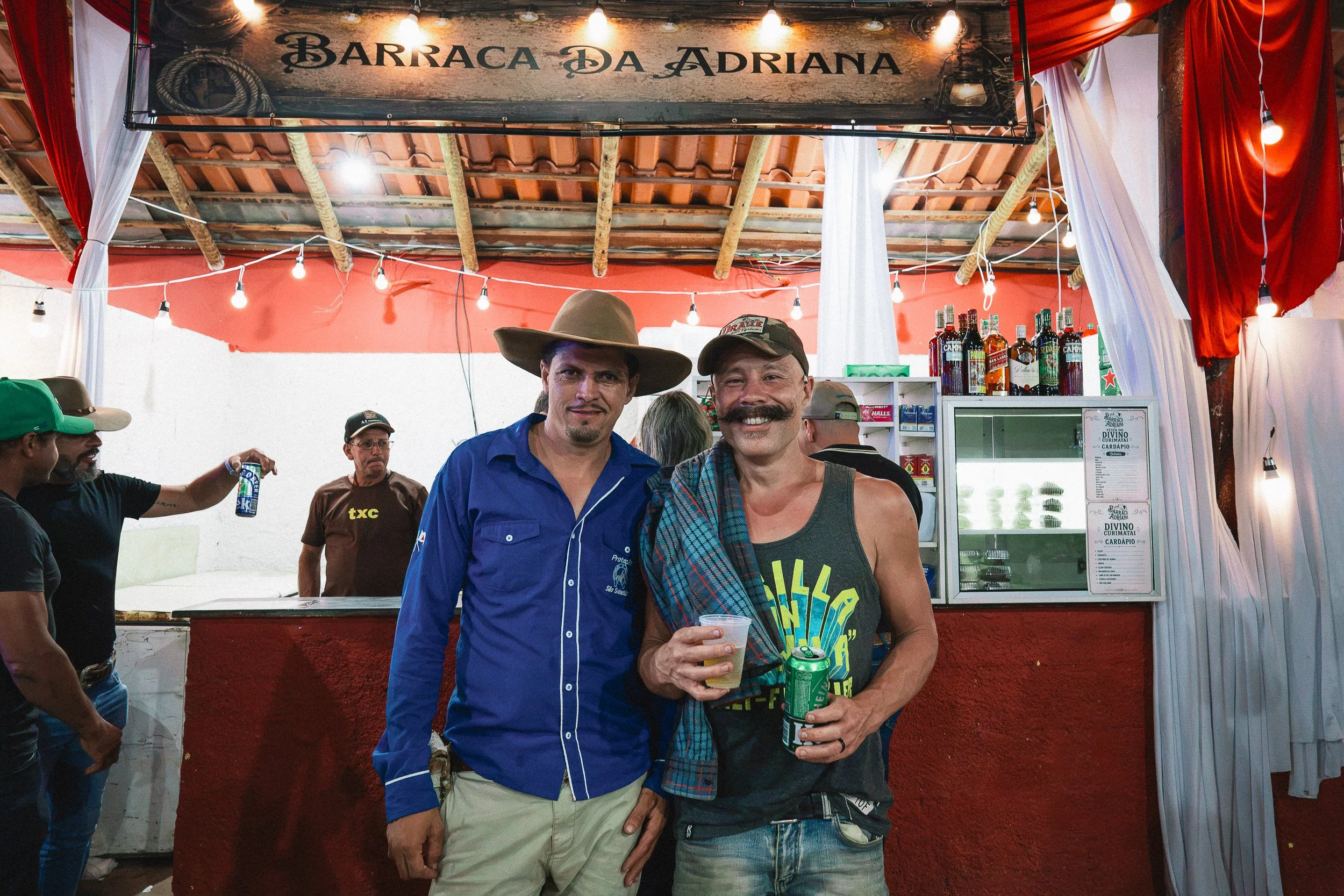
The dogs began to bark. Baiana and the other mule grazed in the courtyard. We called out as we approached and the front door opened. Smiles, embraces, and calls to sit on the sofa to tell stories followed. Guim cooked us dinner (mexidão) and rode out on his motorcycle to pick me up a 6-pack of Antarctica (he doesn’t drink himself but insisted he be the one to go, further cementing his place on our crew).
As the television played softly in the background, Moises cut and rolled a pair of fresh palheiros. Elisa and I were still glowing from the trip and I could see he knew it and was tickled.
He asked us what we had thought of the journey. We told him the truth: it had been one of the most incredible experiences of our lives.
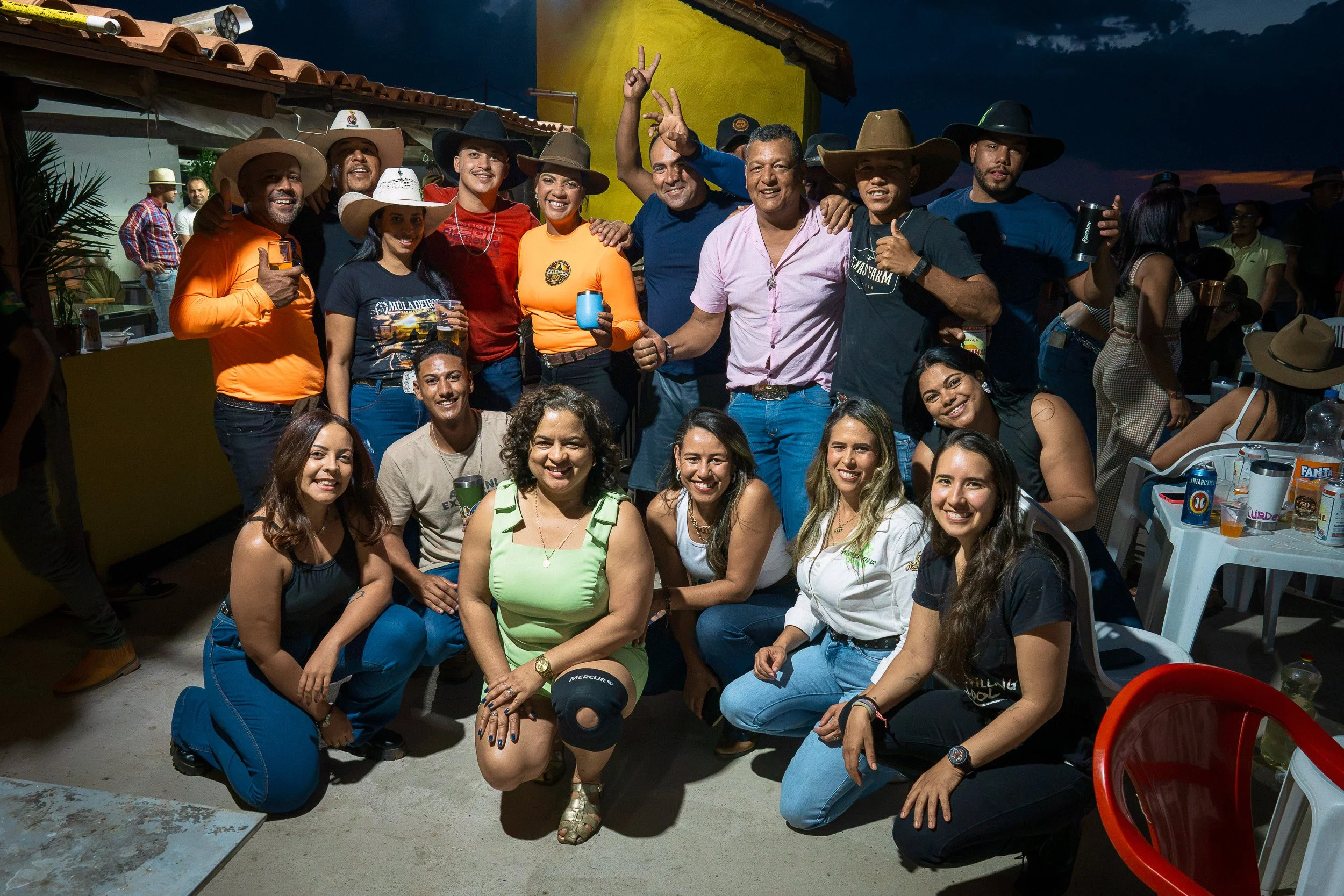
The Santa Rita Crew!
Branqinho’s house, Day 12
XII.
The celebration begins | Alves’s house | Curimataí | Branquinho | The Santa Rita Crew | A party for the ages
On paper, the hardest part of the field trip was behind us. In reality, we’d somehow trekked less than 100 km in 6 days—a decidedly un-GOGO stat line—and still had 3 days of straight partying ahead.
Unbeknownst to me, that celebration would begin the very next morning at Alves’s house, just two kilometers away along cattle trails and creeks. Elisa and I had promised to visit him in town, and we were in no rush to get to Curimataí. She drove Gaúcha. Guim rode Baiana. I walked.
I hadn’t even considered what Alves’s house in town might look like, but it’s also true we’d met him in a cave where his bedroom consists of a mattress under a rock overhang. When we arrived at a gorgeous front porch, draped in lush plants and surrounded by all manner of trees, I was shocked. Inside, the house is simple, spacious, and elegant, with a large and distinct kitchen table and wood-fired stove setup that I immediately (and excitedly) recognized.
I’d been there before, briefly for coffee, with Júlio in 2022 after descending the serra. All this time I’d thought I might have visited one of Guim’s other family members that day, but it was Alves. I asked him whether he remembered a gringo coming out of the hills, exhausted, and he laughed and confirmed the details.
We spent the rest of the morning there around his kitchen table with him and Aline, eating carne de sal and mandioca frita with small toothpicks and listening to stories about Pé de Serra (where he grew up fighting over girls with the boys from the surrounding communities—all of whom he is friends with today, and many of whom Elisa and I know well) and Belo Horizonte (where he once quit his job as Chef de Cuisine because they required him to cut his mustache) and Iraq (where he loved living and working as a waiter in the years following the Iran-Iraq War). Alves hasn’t drunk alcohol in years, but he always keeps fine local cachaça in the house for special occasions, and as he told us these incredible tales, he also attended to our small cups. We must have spent four hours there, leaving the table only briefly to pick oranges from the orchard just outside the back door and visit the waterfall next to the house.
The conversation was so good that—to Alves’s delight—I admitted to having second thoughts about going to Curimataí, but Elisa reminded me that we’d already promised Gilma we’d attend, and that we’d already cut our stay at her home short by a night due to another party in the region (more on that in a moment).
With heavy hearts we said goodbye and promised to catch up again soon, whether here in town or in the serra. (Note: as I write this, Elisa and I are preparing to see him this coming weekend at the party in Pé de Serra).
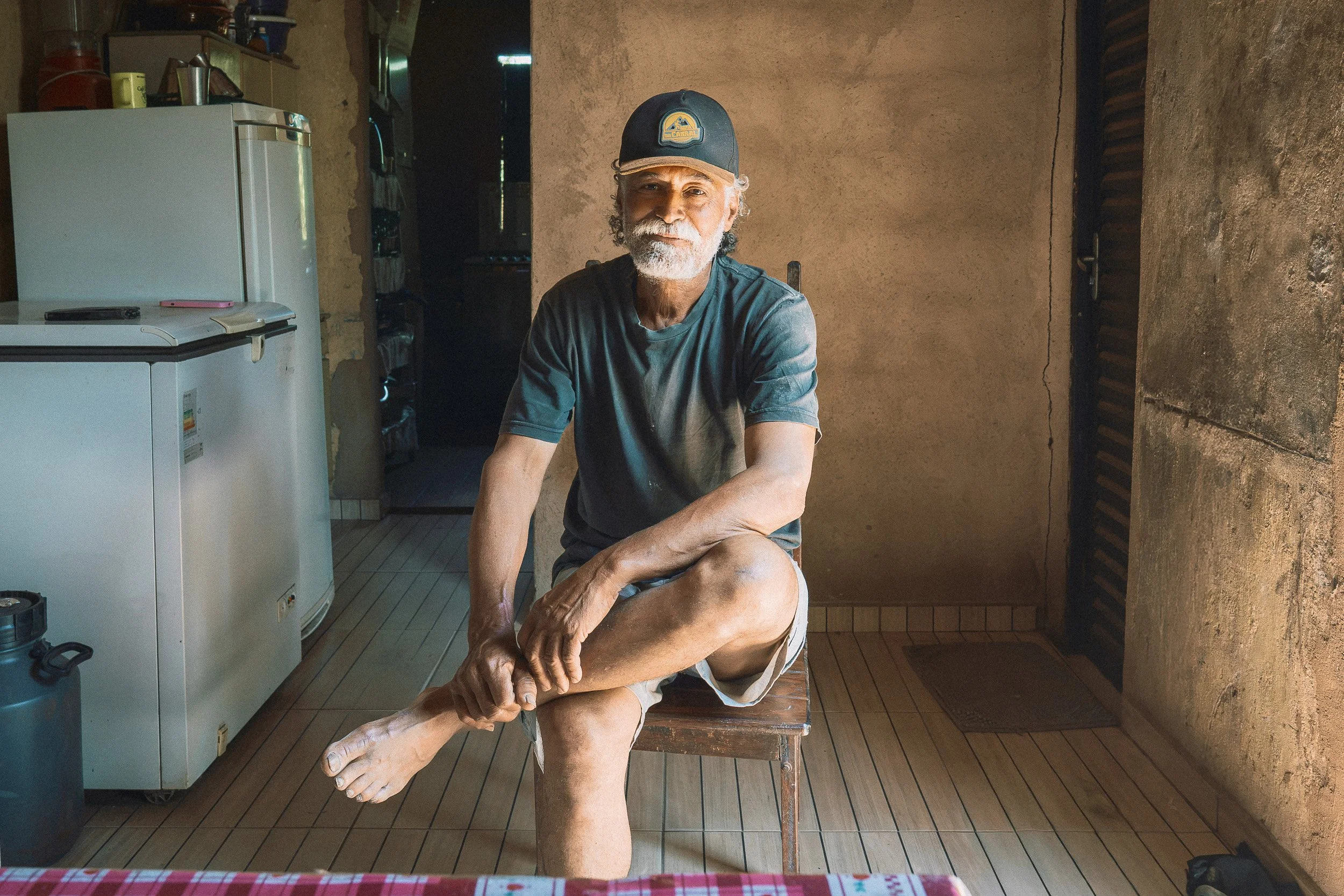
From Alves’s house, Elisa (who’d sipped more café than cachaça) drove us to Gilma’s house in Curimataí. Ten kilometers of big views and bucolic dirt roads, with a few pleasant stops along the way to say hi to folks who recognized us (including none other than Guim and Baiana, who’d decided to go to the party after all). Curimataí is one of our favorite communities to spend time in the Espinhaço, and Gilma’s house is at the very top of our list as both an accommodation and (especially) a place to eat and “unwind”.
She and her husband Tau greeted us as soon as we pulled up, and the unwinding began. (As proof of our good time in the serra, I’d completely forgotten about the laptops and “party duffels” we’d dropped off at their house way back on Day 4. I wasn’t in the mood to work, but it was great to have clean clothes!)
After quite a few rounds with Tau, I took a long and satisfying nap. When I awoke, the annual festa had commenced, and Elisa and I walked downtown to take it in. Tomorrow night was the “big night” of the party, but the turnout was large enough, the band animated, and the mood joyous. Guim was there, as were various friendly faces from Macacos, Inhaí, and São João. We stayed until late, said one last goodbye to Guim, and walked back to Gilma’s, happy with the day’s events.
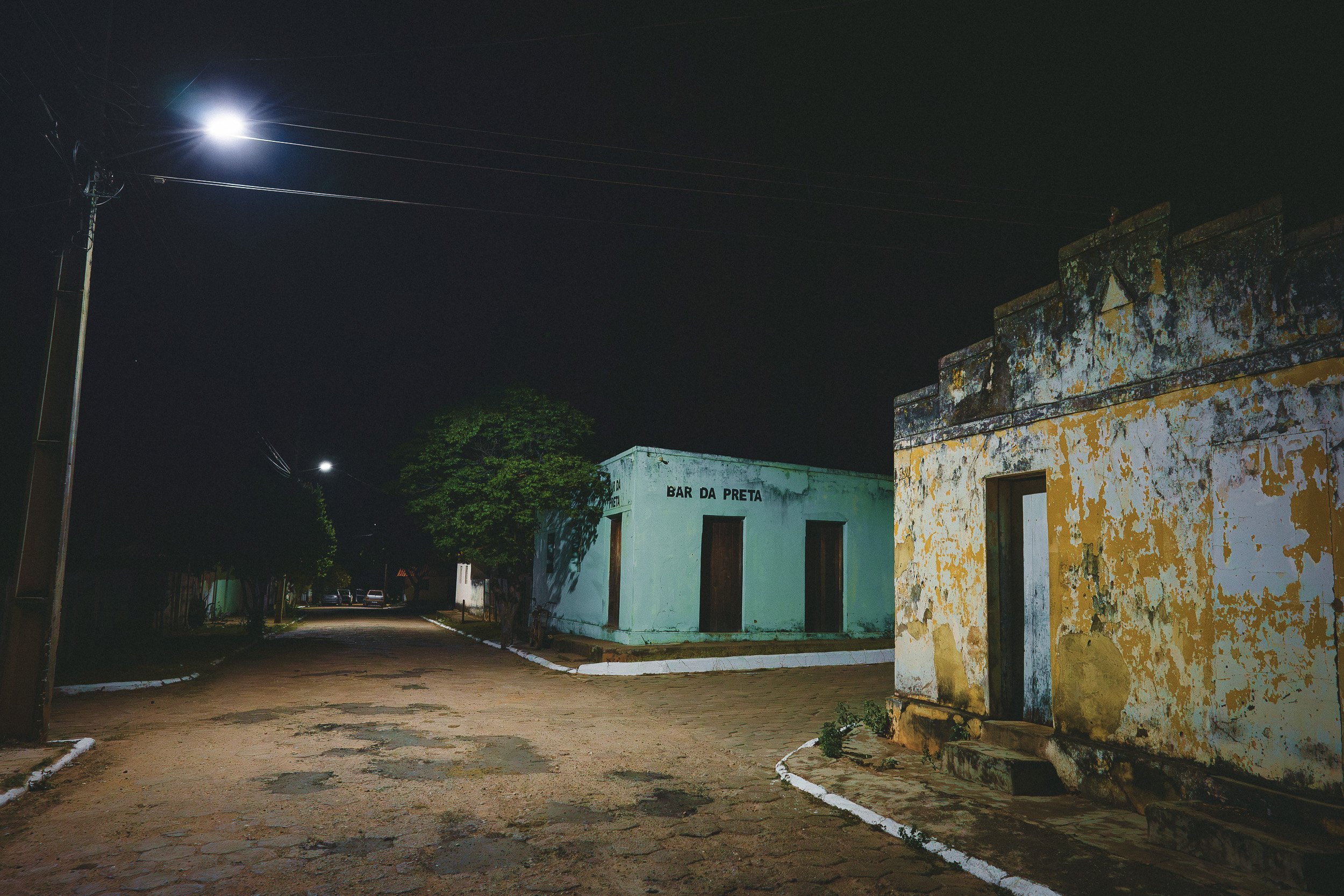
I believe I have time for a final backstory, which I should have mentioned earlier. During our roadtrip to the council meeting at the resort in Texeiras on Day 1 (remember that?), as Elisa and I were pulling out of the gas station in Diamantina, a good friend of ours from Santa Rita, Branquinho, called out and waved as we passed by. I immediately remembered that his 50th birthday had been coming up and that I’d forgotten to respond to the invitation.
After a quick check of the calendar and Elisa’s unenthusiastic confirmation that it was indeed still possible for us to attend (and also a brief argument/existential dilemma about the logistics of the field trip and my unfailing ability to complicate things at the last second), we decided that we would indeed like to go. It would mean one night less at the festa in Curimataí (which we’d been looking forward to for months) and a long day of very bad roads on Saturday, but it also meant a chance to celebrate an important milestone with a dear friend, and to visit with the Santa Rita gang.
Sure enough, as Saturday morning came around, I found myself not particularly in love with the idea of driving five hours along the worst roads in the Espinhaço* (not including Sempre Vivas). We were both tired, I was slightly hungover, and it was already hot. Gilma’s brother Gleiton (who I’ve grown quite fond of over the years) and his wife were staying at the pousada for the weekend, and the front porch was right there. Tau was mocking us, Heineken somehow already in hand.
It would have been easy to stay another night, but we found the strength to push onward, saying goodbye to Gilma, Tau, Gleiton and his wife, that lovely front porch, and the sertão.
Back into the serra we went, this time via poorly vented 1989 Toyota Bandeirante. The road from Curimataí to Branquinho’s house near Guinda is terrible, but the driving experience is par excellence. It’s impossible to crawl along the cratered roads of Santa Rita or cross the fender-high waters of the vast Rio Pardo and not marvel at the madness and beauty of it all.
Once the most delicate stretches of road were behind us, we began to race the setting sun, arriving at Branquinho and Ana Claudia’s gorgeous cliff-side home just in time to watch the sun set behind the iconic outline of Tromba d’Anta mountain.
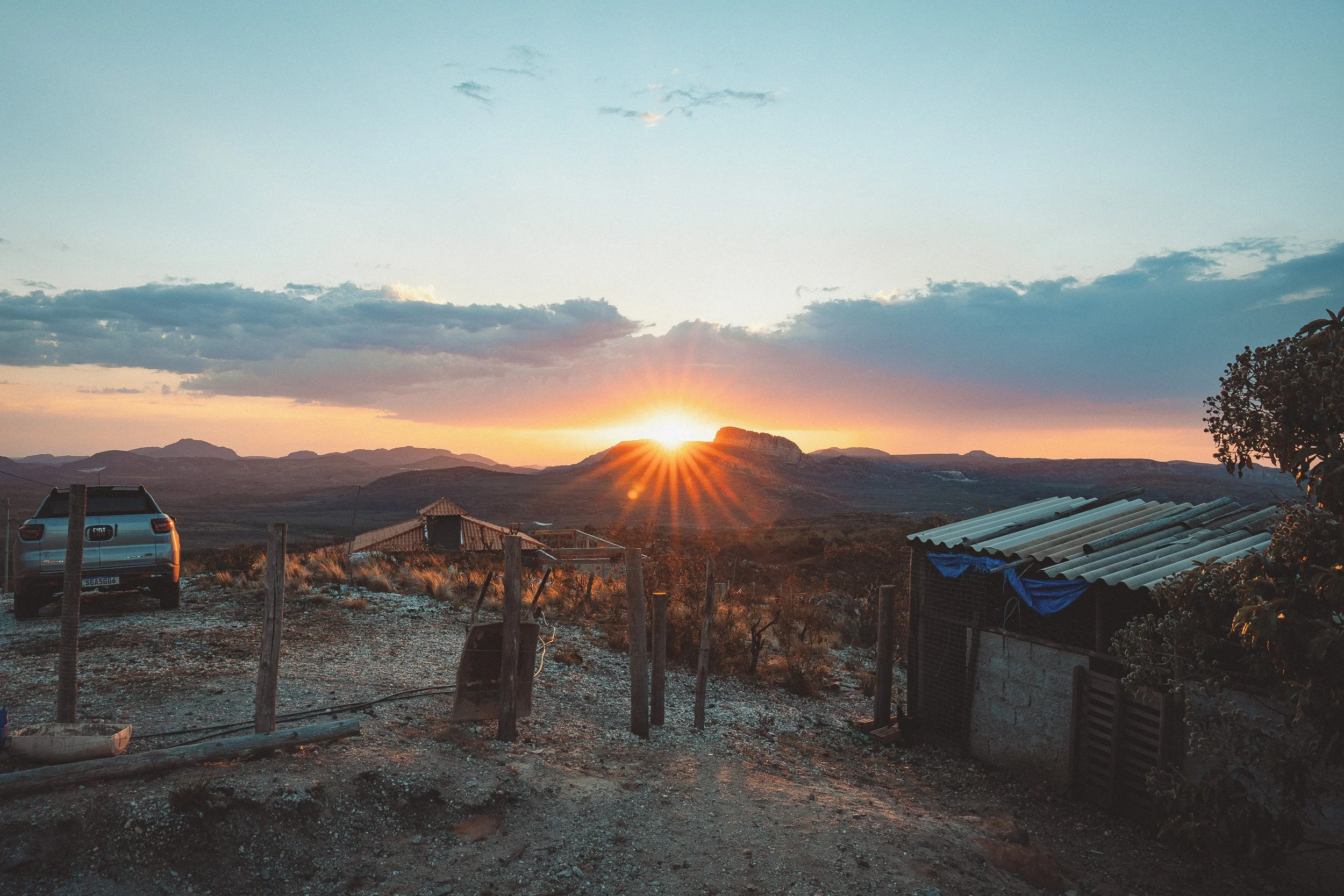
The atmospheric difference between the annual 7 de Setembro festa in Curimataí and Branquinho’s 50th birthday party struck me as that between a stadium concert and a house party. In the former, you go to watch something from a safe distance and end up rubbing shoulders with strangers. In the latter, you go to rub shoulders with people you know.
But pictures are worth a thousand words:
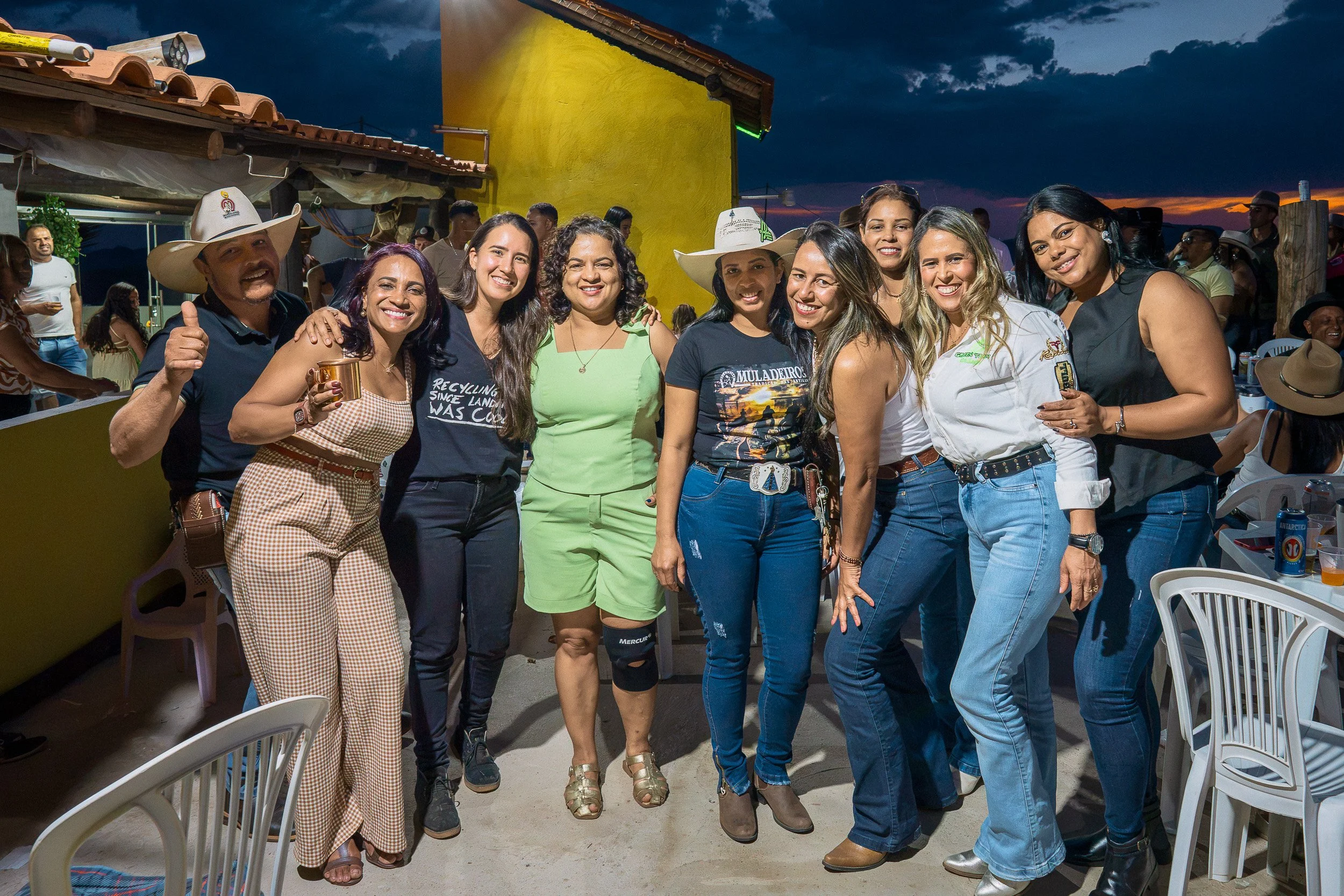
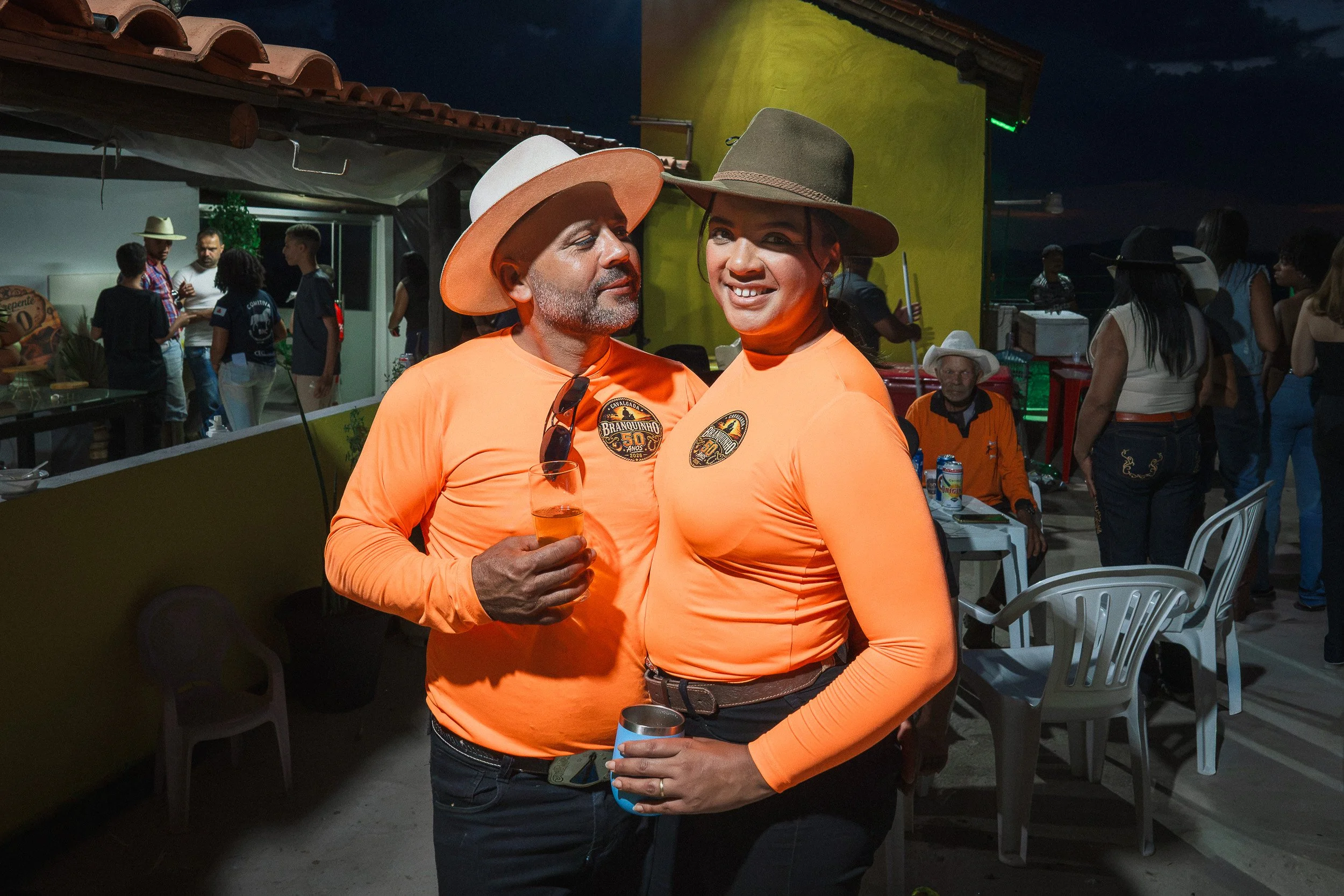
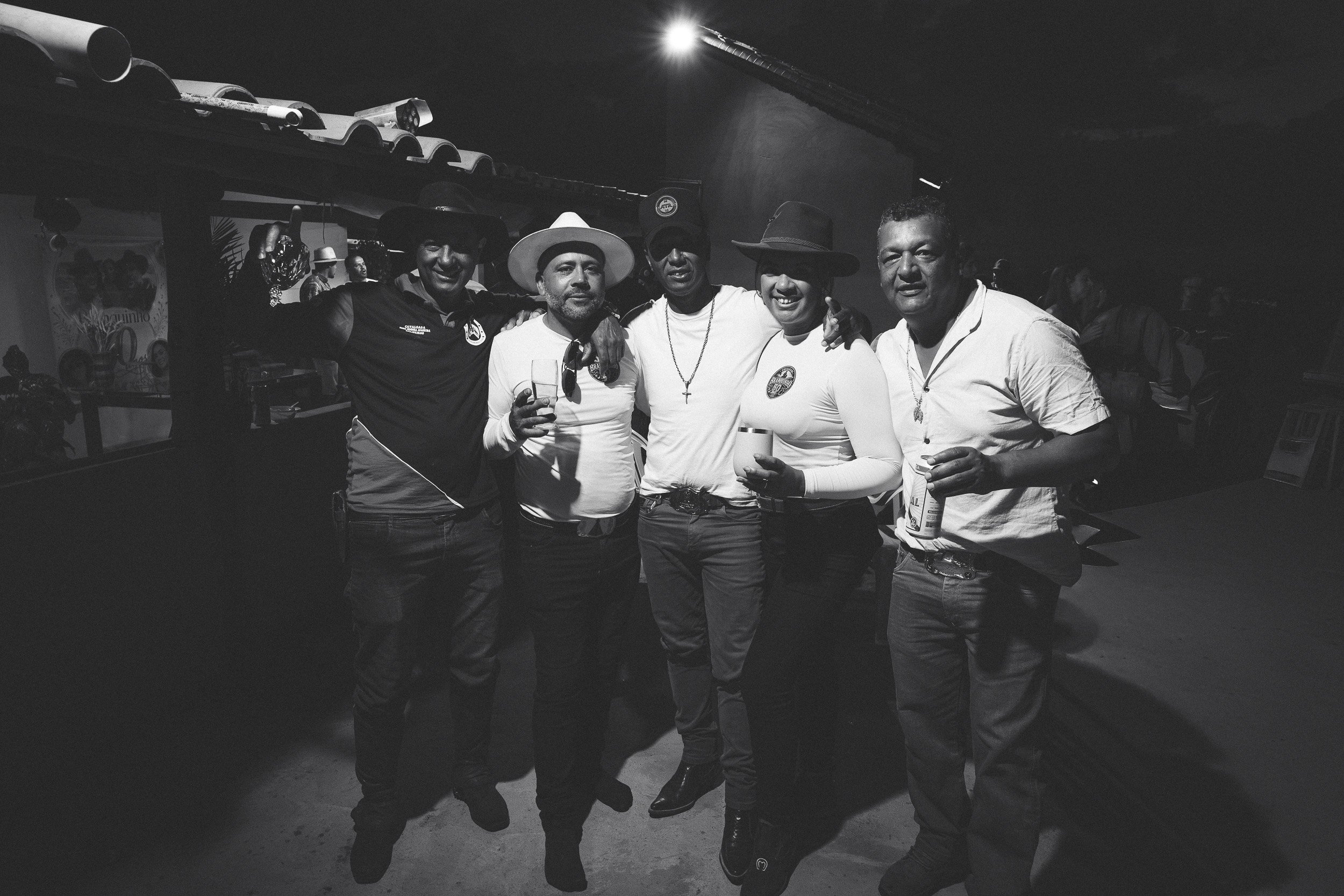
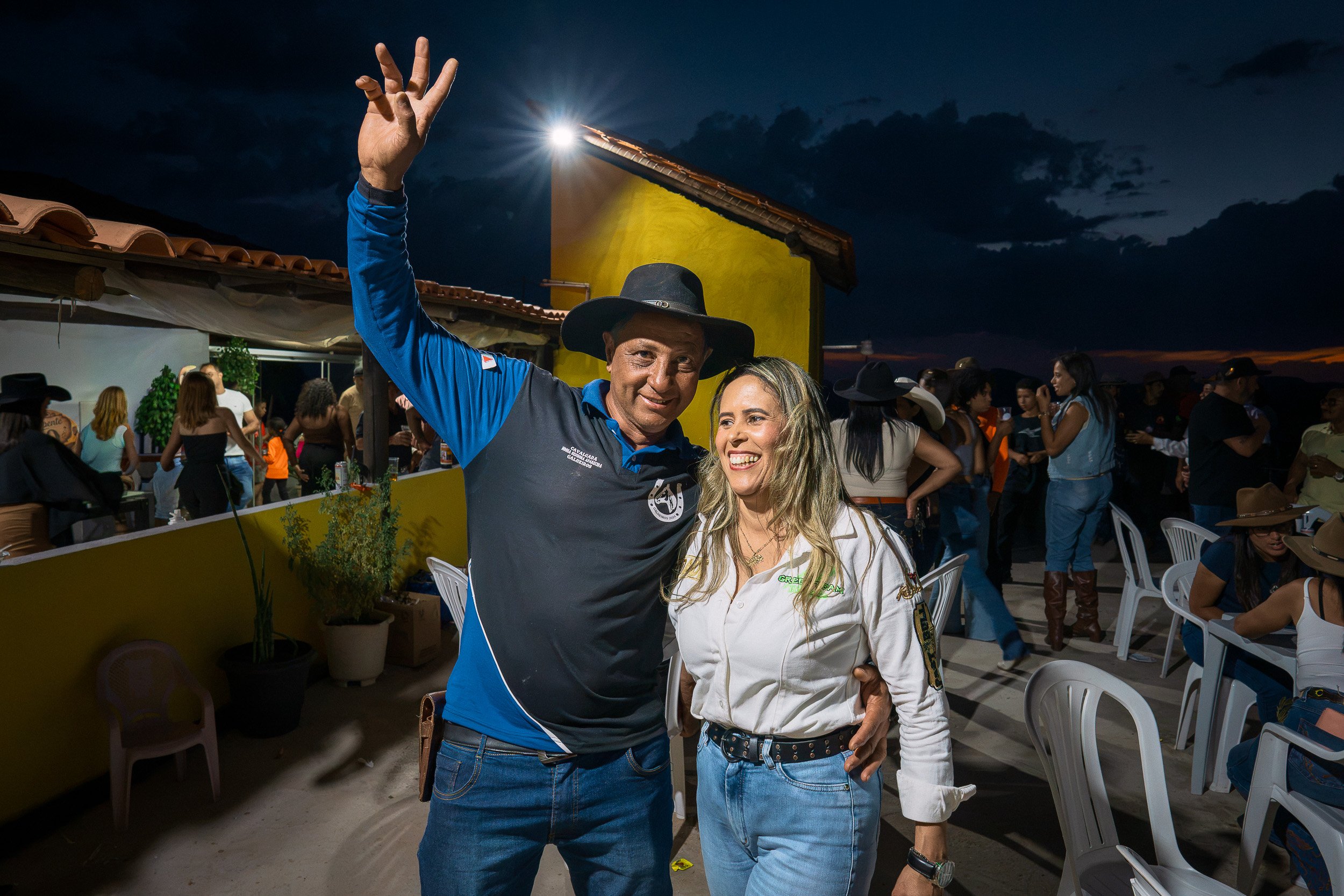
We knew the Santa Rita crew (and their horses) would be there, so we expected the party to be fun and last well into the night. What we didn’t expect—besides the view from their new, Olympic-pool-sized concrete porch—was that the celebration would spill into the next day and evening—across multiple communities. (I’d forgotten that the following day was a national holiday everywhere, not just in Curimataí.)
We stayed until nearly daybreak, then accepted an offer to stay the night at Pê and Nica’s house in the nearby flower-picker village of Galheiros—where Geraldo was born and raised. The festivities recommenced the next morning over brunch on the front porch, with friends, family members, and neighbors joining in.
Nica’s mother—Neura’s sister, who hadn’t seen her in years—was there, and we were able to show her videos and photographs from our time in Campos João Alves. (As the crow flies, Galheiros to Campos João Alves is no more than 40 miles; by road and trail, it’s a two-day journey.)
From Galheiros, we made another trip to Branquinho’s house, with more food, more laughter, more celebration. At one point, Branquinho, clearly moved by the presence of so many who had traveled so far to spend this special moment with him, asked all in attendance to bow their heads in prayer.
For him. For his wife and family. For all of us, whom he loved dearly. For fifty more wonderful years.
And for life in this beautiful, magical place we call home.